
Key Takeaways:
- File to Claim: Proper lottery seller income tax filing is the only legal way to get back the 2% TDS taken from your agency earnings.
- Business Income: The government treats lottery commission as business income, not “other income.”
- ITR-3 Requirement: Because you earn commission, you generally cannot use the simple presumptive tax form (ITR-4). You must file ITR-3. * Checking Records: Always match your distributor’s bills with your Form 26AS/AIS before you send in your return.
Every time you sell a batch of tickets, the distributor takes Tax Deducted at Source (TDS) out of your profit. Over a full year, this 2% cut grows into a large amount. Mastering your lottery seller income tax filing is the only way to recover this money, because it acts as an advance tax payment sitting with the government.
To get it back, or to use it to pay your total tax bill, you must understand how the law handles . Filing an Income Tax Return (ITR) correctly stops warning letters from the tax office and helps you keep your hard-earned money.
This guide walks you through the exact steps for an accurate itr for commission income, which forms to use, and how to report your money safely.
Is Commission Business Income or Other Income?
Many new agents mix up their seller profits with lottery winnings. The Income Tax Act treats them very differently.
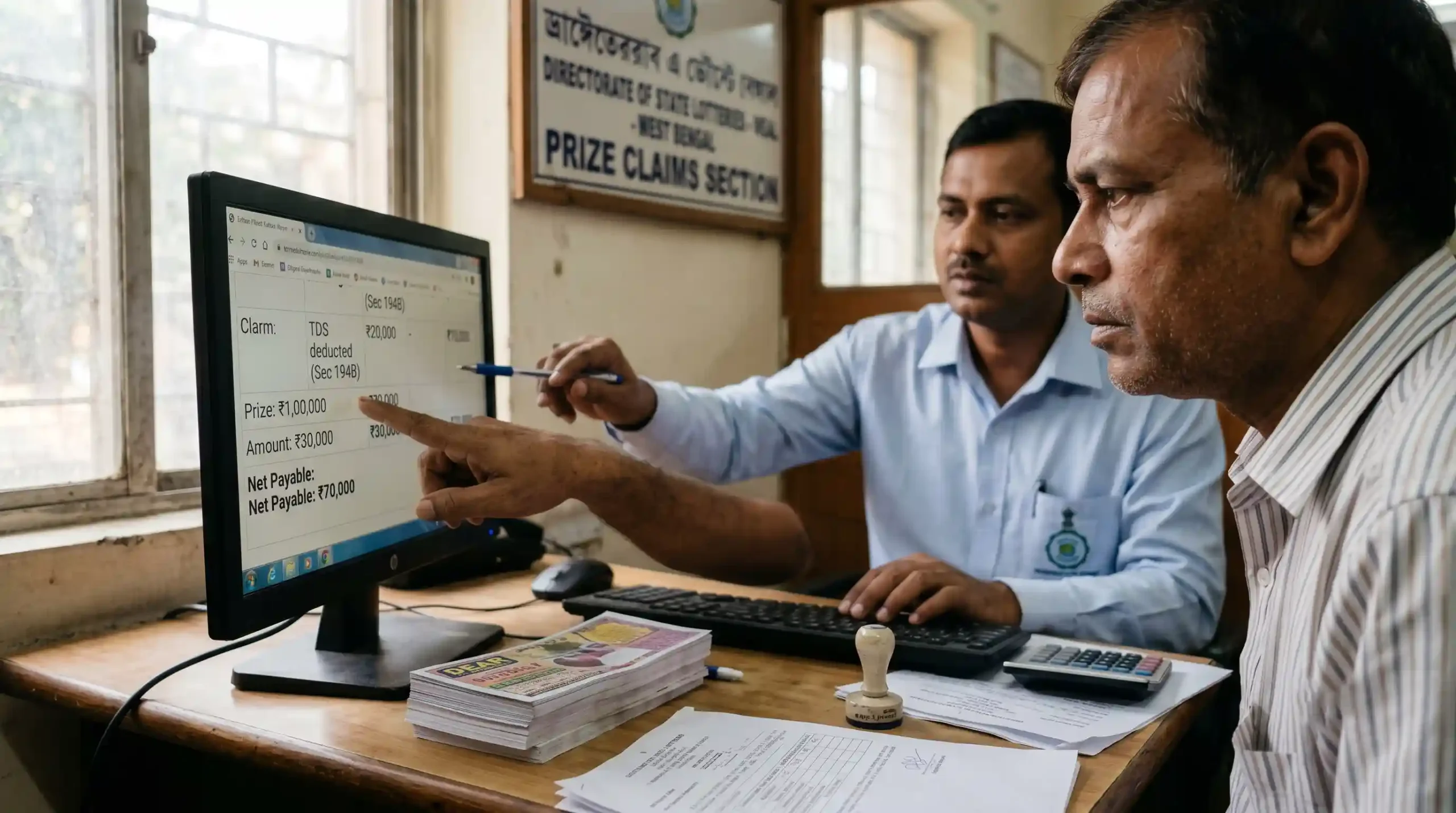
If you win a lottery, the government taxes the prize at a flat 30% under Section 194B (shifting to Section 393(3) Sl.No.1). You can read more about that in our general guide.
However, if you are an agent, the law sees your commission strictly as Profits and Gains of Business or Profession (PGBP). It is your daily work. The distributor takes a 2% TDS under Section 194G (shifting to Section 393(3) Sl.No.4 by April 2026). Because it falls under the lottery business income tax rules, you can subtract real business costs (like shop rent, printing, or helper pay) from your total commission before you calculate your final tax bill.
Step-by-Step: The Lottery Seller Income Tax Filing Process
Doing your lottery seller income tax filing requires the right paperwork to ensure you get your 194G tds refund without causing a tax audit.
Step 1: Check Your TDS in Form 26AS and AIS
Before you file, log into the official Income Tax e-filing portal. Download your Annual Information Statement (AIS) and Form 26AS.
These pages list every rupee of TDS your distributor paid under your PAN. If the distributor kept the TDS but failed to pay it to the government, it will not show up here, and you cannot claim it. Fix any missing numbers directly with your distributor first.
Step 2: Pick the Correct ITR Form
Choosing the right form is very important. Because selling lotteries earns you commission, special rules apply to you.
No Presumptive Taxation: Under Section 44AD(6) of the Income Tax Act, anyone who earns money from “commission or brokerage” cannot use the simple presumptive tax setup. Therefore, a presumptive tax agent filing with ITR-4 is usually wrong for lottery sellers. You must use ITR-3. #### Step 3: Find Your Net Income and Expenses
Since you file under normal business rules (ITR-3), you must figure out your actual net profit.
Take your total gross commission for the year and subtract your business costs. Allowed costs usually include:
- Rent for your lottery stand or shop.
- Electricity and internet bills for the work.
- Pay given to helpers.
- Travel costs tied directly to picking up tickets.
Step 4: Report the Income and Send It In
Type your net business income into the PGBP section of the ITR-3 form. The website will automatically figure out your total tax bill based on your tax bracket.
Next, go to the “Taxes Paid” section. Here, the system will apply the 2% TDS your distributor already took out against your tax bill. If the TDS amount is higher than your actual tax bill, the portal will ask for a refund for the extra money.
Checking Your GST Rules
While filing your income tax, do not forget your other tax duties. The two tax systems often check against each other.
If your commission income crosses the required limit, or if special tax rules apply to your exact distributor contract, you must also follow GST rules. Read our clear guide on to make sure your records line up perfectly.
Filing Action: If you do not know how to build a profit and loss statement for your ITR-3, do not guess. Hire a registered Chartered Accountant (CA). Paying a CA is an allowed business cost, and they will make sure your 2% TDS refund comes through smoothly.
Frequently Asked Questions
Tax Forms and Income Types
1. How do lottery agents file income tax? Agents file their taxes by figuring out their total gross commission, taking away allowed business costs, and sending an ITR form (usually ITR-3) on the Income Tax e-filing portal. This lets them claim credit for the TDS their distributor took out.
2. Is commission business income or other income? The Income Tax Department groups lottery agent commission under “Profits and Gains of Business or Profession” (PGBP). They do not treat it as “Income from Other Sources.” 3. Which ITR form should a lottery seller use? A lottery seller should almost always use ITR-3. Since the money comes from commission and brokerage, the law blocks them from using the simpler presumptive tax form (ITR-4).
4. How do I claim 194G/393 TDS credit? You claim the credit by filing your ITR. The TDS taken by the distributor will show up in your Form 26AS. When you file your return, the portal uses this TDS amount to pay your total tax bill. If you paid too much, it triggers a refund.
5. Can I deduct expenses against commission income? Yes. Because it is business income, you can deduct real costs you paid to run your lottery agency, such as shop rent, electricity bills, internet, and worker pay.
Expense Rules and Getting Your Refund
6. Do I need to maintain books of accounts? Yes. Since you claim business costs and cannot use the simpler tax setup, the law requires you to keep basic record books (like a cash book and cost receipts) under Section 44AA if your income passes certain limits. 7. Is presumptive taxation available for agents? No. Section 44AD firmly blocks taxpayers who earn money from commission or brokerage. Because of this rule, lottery agents cannot use the presumptive tax setup. 8. What if my TDS is more than my tax liability? If the 2% TDS taken out all year adds up to more than the final tax you owe, the Income Tax Department will send a refund for the extra money straight to your linked bank account after you file your ITR.
9. How do I report commission in the ITR? You report your total commission, minus your allowed business costs, in the section called “Profits and Gains of Business or Profession” (PGBP) inside the ITR-3 form.
10. What happens if I don’t file as an agent? If you do not file, you lose your right to claim a refund on the TDS taken from you. Also, if your total income is higher than the basic tax-free limit, the tax office can send a warning letter and charge you fines.
Next Steps: Before you finish your lottery seller income tax filing for the year, ensure you know exactly how the 2% cut works at the source. Read our plain breakdown of the new rules to check that your distributor is taking the right amounts.