
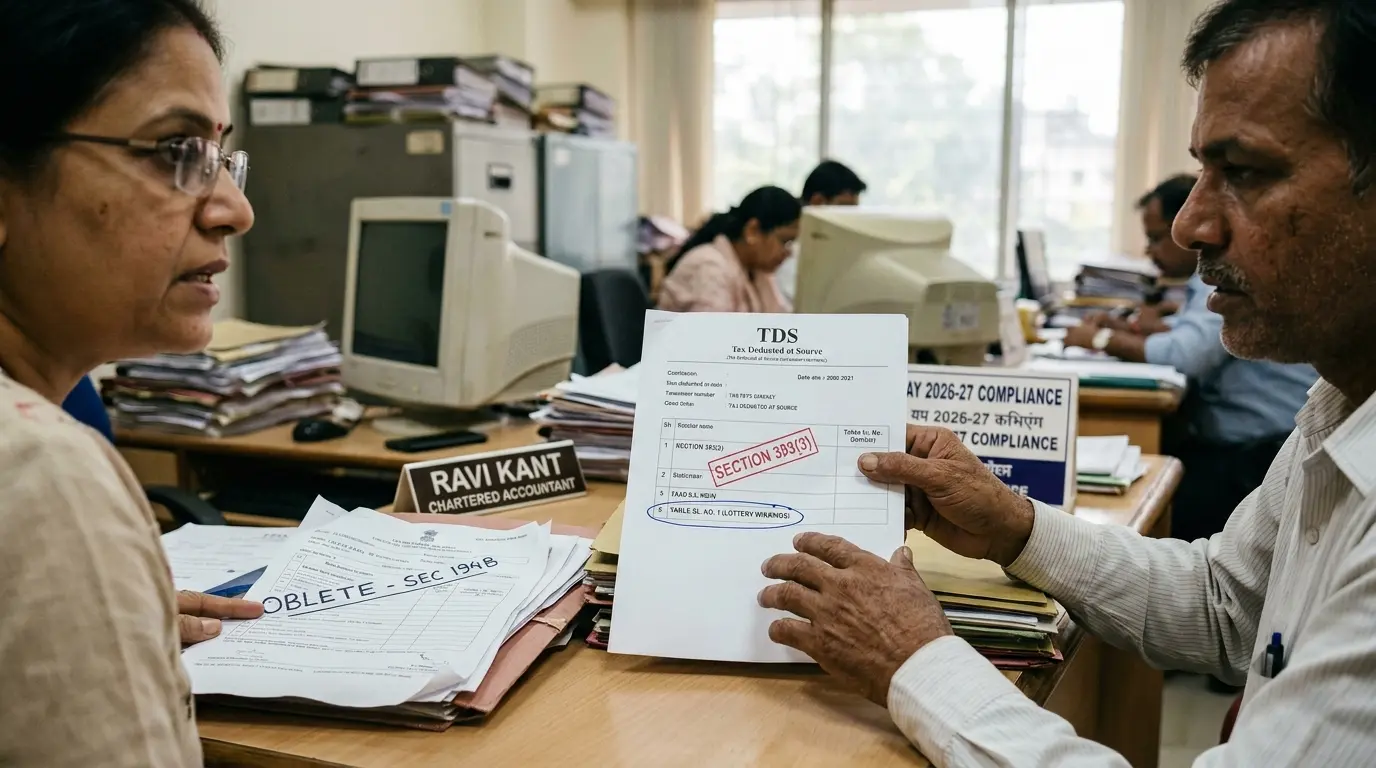
The transition to the new fiscal era brings massive structural updates that every tax professional and lottery winner must master. The legislature has officially retired Section 194B. The freshly enacted Income-tax Act, 2025 completely restructures how authorities track windfall income, shifting the entire mechanism to a new legal code. If you reference the obsolete section code on your upcoming tax return, the central processing system will automatically reject your filing.
To file your returns without errors, you must understand how the updated Lottery Tax in India: The 31.2% Rule Winners Miss operates under this rewritten statutory framework. While your core financial liability remains unchanged, the legal mechanics require a completely fresh compliance approach. Let’s break down the essential statutory changes mapping out your tax obligations for the current assessment period.
Key Takeaways
- Statutory Renumbering: The Income-tax Act, 2025 officially replaces the legacy Section 194B with the newly minted Section 393(3) effective April 1, 2026.
- Identical Tax Rates: The structural reorganization alters the section numbers but maintains the flat 30% base tax and 4% cess layout.
- Threshold Preserved: The ₹10,000 tax deduction threshold survives the transition, applying strictly to individual transactions.
- Filing Mandatory: Taxpayers must utilize the updated Section 393 citations when completing their AY 2026-27 tax forms to prevent immediate processing errors.
Decoding Lottery Tax Under Section 393: What Has Changed?
The Structural Sunset of Section 194B
For decades, taxpayers tracked lottery withholdings exclusively through Section 194B. However, the legislative overhaul taking full effect on April 1, 2026, completely retires this familiar code. The government introduced the Income-tax Act, 2025 to clean up historical layers of amendments, consolidating varied windfall codes into streamlined chapters.
Under this new architecture, the old section vanishes entirely from active filing procedures. Administrators now track all domestic lottery payouts through the newly codified provisions. You can read the official announcement and track statutory updates directly on the Income Tax Department of India portal.
Old vs New Section Mapping for 2026
The legal update extends beyond a single line item. The legislature has systematically remapped the entire framework that governs speculative income, prize draws, and withholding duties. This structural shift alters the labels across your entire tax ledger.
The transition leaves no legacy codes behind for traditional paper games. To keep your books accurate, review this official structural shift:
- Legacy TDS Withholding: Section 194B shifts directly into Section 393(3).
- Legacy Charging Provision: Section 115BB transitions into its new counterpart under the 2025 Act.
- Legacy Expense Disallowance: Section 58(4), which blocks expense claims against winnings, maps to a new restrictive clause.
Key Operational Rules Preserved Under Section 393
The Survival of the Per-Transaction Threshold
Many taxpayers worry that a new law means the total elimination of basic tax thresholds. Fortunately, the foundational ₹10,000 threshold survives this major legislative revamp intact. The tax department retains the updated per-transaction standard established during the previous fiscal year.
This means ticket agents and state distributors calculate your liability on individual payouts rather than your seasonal tournament accumulation. To explore how this mechanism filters multiple ticket wins, review our complete breakdown of the lottery TDS 10,000 threshold rules.
Tax Rates and Cess Maintenance
While the code names change, the underlying financial math remains completely steady. The government has not used this reorganization to secretly increase your tax bill. Winnings face the same flat 30% base rate alongside the mandatory 4% health and education cess.
This ensures your real-world liability holds flat at a total 31.2% tax rate. If you want to differentiate this traditional structure from digital formats, read our guide explaining why online game winnings tax vs lottery protocols utilize entirely different calculation pathways.
Impact on Filing Your AY 2026-27 Winnings Tax Return
Avoiding Automated ITR Defect Notices
The central tax processing utility uses automated algorithms to screen inbound data against pre-compiled employer and distributor records. If your filed ITR claims a credit using the obsolete 194B designation for a transaction finalized after April 1, 2026, the software triggers an immediate error flag.
The system treats this variation as an invalid credit claim, halting your assessment and dispatching an automated defect notice. You must verify that your accountant updates their software presets to reflect the new legislative codes.
Verifying Section 393(3) Table Sl. No. 1
When you receive your formal tax deduction certificates from state lottery boards, check the statutory declarations carefully. Valid certificates issued for recent draws must explicitly reference Section 393(3) Table Sl. No. 1 to clear processing checks.
Cross-reference these entries against your updated Annual Information Statement (AIS) before submitting your final data packet. If any legacy labels appear on your forms, request an immediate corrected statement from the issuing distributor.
Frequently Asked Questions About Lottery Tax Under Section 393
Legislative and Code Change FAQs
Is Section 194B still valid in 2026?
No, Section 194B is no longer valid for transactions taking place after April 1, 2026. The newly introduced Income-tax Act, 2025 has completely retired the code, replacing it with updated statutory sections for all current windfall earnings.
What replaced Section 194B under the Income-tax Act 2025?
Section 393(3) officially replaces Section 194B under the new legislative framework. This updated code now governs the entire Tax Deducted at Source (TDS) mechanism for lottery prizes, lucky draws, and crossword windfalls across India.
From when does Section 393 apply to lottery winnings?
Section 393 applies officially to all lottery winnings distributed on or after April 1, 2026. Any prize distributed after this launch date falls strictly under the regulatory mandates of the new Income-tax Act, 2025.
Did the lottery TDS rate change under the new Act?
No, the lottery TDS rate did not change under the new Act. The base withholding rate remains fixed at exactly 30%, which combines with the 4% education cess to create an effective 31.2% tax rate.
What is Section 393(3) Table Sl. No. 1?
Section 393(3) Table Sl. No. 1 is the exact statutory line item that mandates tax deductions on lottery prizes. State departments use this specific sub-clause to validate their formal withholding actions when paying out windfalls.
Filing and Threshold FAQs
Should I cite 194B or 393 in my AY 2026-27 ITR?
You must cite Section 393 in your AY 2026-27 ITR for all earnings realized after the new law took effect. Inputting the outdated 194B code will confuse the automated system and trigger a defective return notice.
Did the 10,000 threshold survive the 2025 change?
Yes, the ₹10,000 threshold survived the legislative transition completely intact. The tax department continues to apply this exemption limit on an individual per-transaction basis rather than tracking an aggregate annual total.
Are old TDS certificates referencing 194B still valid?
Old TDS certificates referencing 194B remain valid only if they cover financial transactions completed prior to April 1, 2026. You can use them to defend historic filings or handle unresolved back-year assessments.
Which sections replaced 115BB and 58(4)?
The Income-tax Act, 2025 replaced Section 115BB with a modernized charging clause, while Section 58(4) shifted into a parallel expense restriction rule. These new lines replicate the old absolute ban on deductions.
Where can I verify the new section mapping officially?
You can verify the official section mapping by accessing the complete text of the Income-tax Act, 2025 on the Gazette of India electronic repository or by browsing the primary concordance tables uploaded to the central tax e-filing portal.
Conclusion & CTA
Adapting to structural tax changes ensures you keep your financial life free from unnecessary state legal entanglements. The transition from Section 194B to Section 393 alters the filing labels completely, making proactive software updates an absolute necessity for compliance. Review your financial records, confirm your withholding codes with your lottery distributor, and use the updated legal citations to process your returns smoothly without triggering automated processing faults.