
Group Lottery Win: The Gift-Tax Trap on Shares

Reviewed for Accuracy by: Tax Compliance Editorial Board

Disclaimer: This guide provides strategic compliance insights based on the current Income-tax Act provisions. It does not constitute formal financial or legal advice. Taxpayers must consult a qualified Chartered Accountant (CA) to evaluate their specific tax profiles before filing returns.

Winning a lottery pool with colleagues sounds amazing. However, the tax department might treat the final payout as a taxable gift. Groups often buy tickets under one name. In this case, managing the tax on group lottery winnings in india becomes a critical hurdle. Most office syndicates fail to document their collective intent before the draw occurs.

To see how these rules mesh with standard windfalls, read our Lottery Tax in India pillar page. Failing to secure clear proof of joint ownership will expose your pool members to aggressive tax claims.

📌 Key Takeaways

  • The Single-PAN Risk: First, lottery companies pay the prize money to a single individual under one PAN.
  • Double Tax Threat: Furthermore, distributing the remaining cash to friends without a legal framework triggers secondary tax liabilities.
  • Section 56(2)(x) Exposure: Consequently, non-relatives receiving pool shares over ₹50,000 must declare them as taxable gifts at standard slab rates.
  • The Pre-Agreement Fix: In addition, a legally executed syndicate contract before the ticket purchase completely protects the pool from double taxation.

The Syndicate Dilemma: How Tax on Group Lottery Winnings in India Applies

The Indian tax framework evaluates wealth transfers strictly based on documented financial trails. Primarily, the state does not recognize verbal agreements or casual handshakes when large sums of money move between bank accounts.

Single PAN Claims vs. Collective Ownership Realities

When a lottery pool wins, the distributing organization asks for one primary winner to claim the prize pool. Consequently, the government logs that individual’s Permanent Account Number (PAN). Then, the platform deducts a flat 31.2% TDS upfront.

When the primary claimant tries to wire the remaining shares to co-winners, the banks flag the transfers. The primary winner could face heavy interest penalties. To avoid this, the group must coordinate their filing timelines. For a detailed breakdown of how timing impacts large windfalls, look at our companion guide on Advance Tax on Lottery Winnings.

The Gift Trap and Tax on Group Lottery Winnings in India

Office pools face a major hazard. Taxes can stack up on the exact same cash. If you do not follow proper procedures, the government will collect tax twice on a single winning ticket.

Section 56(2)(x) Thresholds for Disbursing Prize Shares

Section 56(2)(x) targets money transfers from non-relatives. If you receive over ₹50,000 without giving anything in return, you face immediate tax. The tax department treats this as “Income from Other Sources.” You will pay tax based on your regular income slabs.

Step 1: Raw Prize Money ──► Flat 31.2% Windfall Tax Deducted on Primary Winner's PAN
Step 2: Cash Distribution ──► Section 56(2)(x) Gift Tax Applied to Each Pool Member's Share

Therefore, if an undocumented group wins a prize and splits the cash equally, the primary winner pays 31.2% upfront. Following that, each pool member pays up to an additional 30% plus surcharges on their respective shares.

This severe stacking penalty turns a celebration into a financial disaster. This heavy double tax shows why you must understand the tax on group lottery winnings in india before playing together.

Legal Safeguards to Protect Group Winnings From Double Tax

You must protect your collective wealth. Move from an informal group to a legal syndicate before buying a ticket.

Drafting a Pre-Purchase Syndicate Agreement

To minimize the tax on group lottery winnings in india, create a clear paper trail before the draw happens. A valid syndicate contract must include:

  • Clear Identification: First, list the legal names, Aadhaar numbers, and PAN details of every single participant.
  • Proportional Contributions: Second, document the exact monetary amount contributed by each member toward buying the ticket.
  • Explicit Share Breakdown: Third, outline the exact percentage of the prize pool that each individual will receive upon a successful draw.
  • Legal Execution: Finally, print the text on stamp paper. A notary public must witness it before the draw date.

Show the tax department a notarized pre-purchase agreement. They will view the primary winner as a trustee for the group. As a result, officials treat the secondary transfers as true share distributions, not taxable gifts. For formal verification of current compliance frameworks and income definitions, check the Official Income Tax Department Portal.

Frequently Asked Questions

Is a group lottery win subject to gift tax in India?

Yes, group wins can trigger a gift tax if one person claims the ticket. Without a contract, the tax department treats transfers to pool members as individual gifts. This makes the money subject to normal tax slabs.

How do I avoid double taxation on a syndicate lottery win?

You must sign a notarized syndicate contract before buying the ticket. This document proves co-ownership. It allows you to distribute the prize money safely as joint shares rather than taxable gifts.

What is the tax threshold for receiving lottery pool shares?

Under Section 56(2)(x), a gift over ₹50,000 from a non-relative triggers a tax. Without a contract, the department adds this cash to your regular income. You will pay tax at your normal slab rate.

Can a family lottery pool share winnings without gift tax?

Gifts from close relatives are free from gift tax under Section 56(2)(x). However, the primary winner must still pay the flat 31.2% windfall tax. Only then can they gift the remaining funds safely.

Conclusion & Next Steps

In conclusion, a lack of documentation can transform a celebratory group lottery win into an expensive double-taxation trap. The initial 31.2% tax is mandatory. However, good planning protects your cash. Do not let the tax on group lottery winnings in india hit your pool twice.

Therefore, never buy collective tickets based on a verbal agreement. Draft a notarized syndicate contract before every draw. Keep clear logs of all member payments. Finally, consult a tax professional immediately after a win to distribute the money safely.

Why Lottery TDS Won’t Settle Your Full Tax Bill

Reviewed for Accuracy by: Tax Compliance Editorial Board

Disclaimer: This article provides informational context regarding windfall tax compliance under the current income tax framework. It does not constitute formal legal or financial advice. Taxpayers must consult a qualified cross-border tax expert or verify rules against the latest Finance Act provisions before filing.

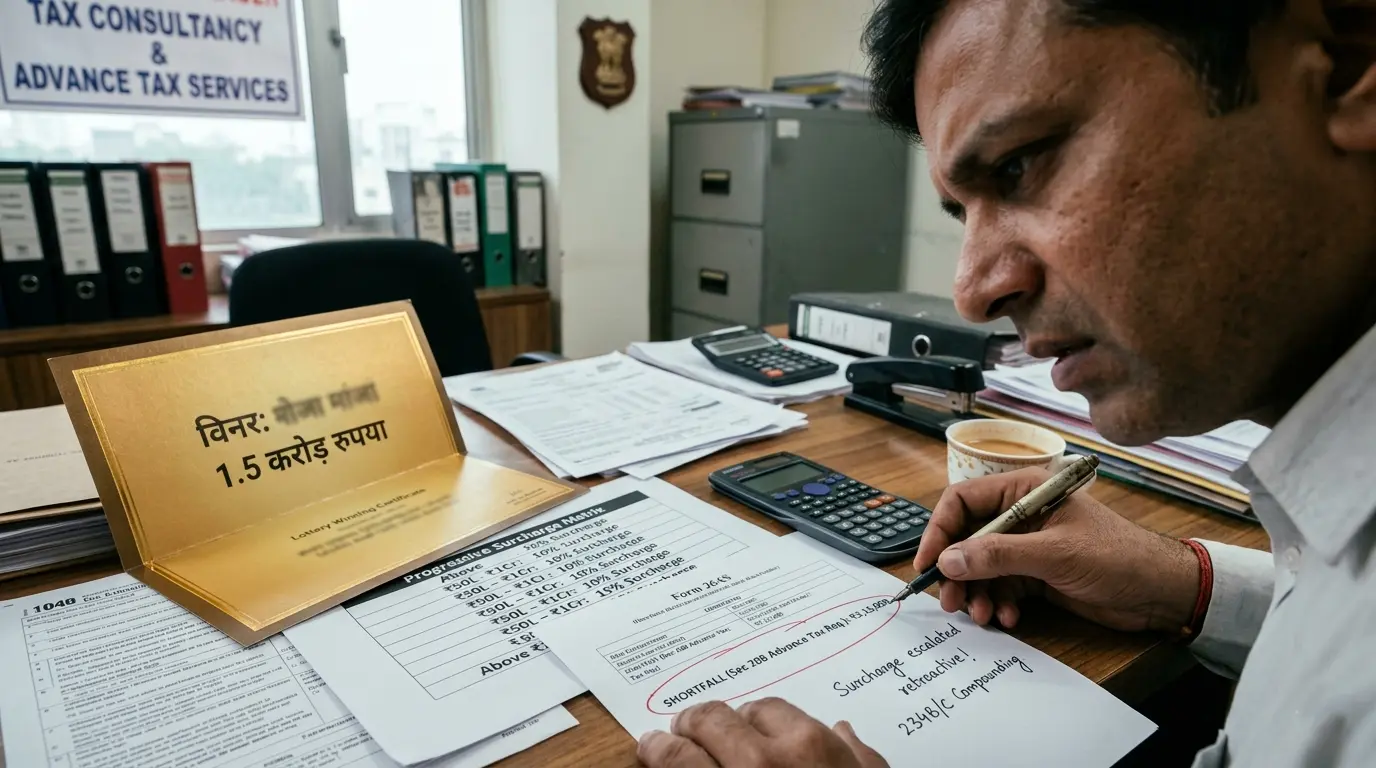
Celebrating a major windfall from an Indian lottery or sweepstakes can be life-changing, but relying solely on the platform’s initial deduction is a critical mistake. Many high-value winners view Tax Deducted at Source (TDS) as a final settlement, completely unaware that they must manually calculate and pay advance tax on lottery winnings to avoid severe compliance penalties.

Therefore, analyzing your true liabilities under the current fiscal year mandates is the only way to safeguard your wealth. This processing system operates under strict automated clearing parameters.

To understand how automated withholdings tie into the overarching master tax code, review our definitive guide on Lottery Tax in India. Failing to clear the resulting shortfall before the quarterly financial deadlines can lead to sudden, systemic bank account freezes.

📌 Key Takeaways

  • Provisional Credit Only: First, the 31.2% withholding executed by lottery platforms is merely an interim payment, not a final tax clearance.
  • The Surcharge Factor: Furthermore, your combined annual salary, business profits, and investments can retroactively push your windfall into higher surcharge brackets.
  • Immediate Deadlines: Section 208 mandates immediate advance tax payments if your residual tax liability after subtracting TDS credits exceeds ₹10,000.
  • Compounding Interest: In addition, ignoring the remaining tax gap results in automated interest penalties under Sections 234B and 234C.

The Mechanics of Lottery TDS vs. Total Liability

The Indian tax framework sets clear boundaries between withholding rules at the source and your final reporting obligations. Primarily, the state uses this system to ensure immediate revenue collection on large prize disbursements.

Under the updated provisions of the Income-tax Act, online platforms, lottery distributors, and contest organizers must deduct tax before transferring windfall funds to a winner. Currently, this equates to a 30% flat tax plus a 4% health and education cess, establishing a baseline 31.2% TDS rate.

However, this systemic deduction is treated as a provisional credit rather than a conclusive clearance of your total tax file. The tax department evaluates your final obligations by looking at your cumulative income profile, which often exposes unexpected tax shortfalls.

Surcharge Escalations and the Need for Advance Tax on Lottery Winnings

The core vulnerability for high-earning winners stems from the progressive nature of the national surcharge matrix. While the lottery organizer calculates TDS purely on the singular prize ticket value, your final tax file aggregates all earnings.

Total Income Aggregation and Surcharge Thresholds

Your total gross income determines the surcharge slab applied to your entire tax file. If your combined salary, business gains, and windfall cross the ₹50 Lakhs threshold, a compounding surcharge kicks in retroactively:

  • ₹50 Lakhs to ₹1 Crore: A strict 10% surcharge is levied directly on your base tax liability.
  • ₹1 Crore to ₹2 Crores: An escalated 15% surcharge applies to your base tax calculation.
  • ₹2 Crores to ₹5 Crores: The surcharge scales up significantly to 25% for high-net-worth individuals.
  • Above ₹5 Crores: The peak surcharge rate reaches 37% for top-tier earners.

Because the deductor may only apply the baseline rate without factoring in your external wealth, this hidden discrepancy creates a massive funding gap in your file. Failing to calculate this compounding liability leaves you exposed to aggressive under-payment penalties. Non-resident players face an even more complex cross-border framework, which you can analyze in our guide on NRI Lottery Winnings Tax in India.

Section 208 Mandates and Advance Tax Schedules

Relying on year-end reconciliations to pay off your residual tax gap is a highly expensive mistake. The income tax framework enforces strict quarterly payment schedules that apply to all forms of taxable income.

Under Section 208, any taxpayer whose residual tax liability exceeds ₹10,000 after subtracting TDS credits must pay Advance Tax. Because a lottery win occurs as an unpredictable, sudden windfall event, it instantly triggers these advance compliance rules.

Failing to pay advance tax on lottery winnings before the quarterly deadlines causes the e-filing portal to automatically assess compounding interest penalties when you submit your return. Specifically, Section 234B and Section 234C interest charges accrue at 1% per month for delayed or skipped payments. To ensure full alignment with updated electronic payment formats and deadlines, always cross-reference your schedules with the Official Income Tax Department Portal.

Reconciling Form 26AS, AIS, and Your Final Tax File

Before attempting to file your annual returns, you must reconcile your data across multiple digital governmental ledgers to ensure absolute compliance.

Your Form 26AS ledger must show the exact TDS amount deducted by the organizer under the correct tax category. Simultaneously, the Annual Information Statement (AIS) tracks your digital banking trail to ensure the windfall amount matches perfectly.

If your prize was relatively small, you can cross-reference these logging steps with our guide on income tax on lottery winnings below 10000. When evaluating your total liability and computing the required advance tax on lottery winnings, you must ensure perfect data alignment across all forms to prevent the automated generation of mismatched compliance notices.

Frequently Asked Questions

Why do I need to pay advance tax on lottery winnings if TDS was already deducted?

TDS only covers a baseline tax rate of 31.2%. If your total annual income, including the lottery windfall, exceeds ₹50 Lakhs, progressive surcharges apply retroactively. You must pay advance tax to cover this shortfall if your residual liability exceeds ₹10,000.

What are the interest penalties for skipping advance tax on lottery winnings?

Skipping advance tax triggers interest penalties under Sections 234B and 234C. The tax department charges compounding interest at a rate of 1% per month on the unpaid tax shortfall from the deadline date until the balance is fully cleared.

How do I calculate advance tax on lottery winnings with other incomes?

You must estimate your total annual income, including salary, business profits, and the gross lottery prize. Compute the total tax and applicable surcharges, subtract the TDS already deducted, and pay the remaining balance across the standard quarterly advance tax installments.

Can I clear my lottery tax shortfall during regular ITR filing?

While you can pay the remaining balance during ITR filing, doing so will attract heavy interest penalties under Sections 234B and 234C. To avoid these extra charges, you must pay the tax via the advance tax portal during the financial year you won.

Conclusion & Next Steps

In summary, the belief that lottery TDS settles your full tax bill is a dangerous financial blind spot. While the organizer’s upfront deduction covers the baseline tax rate, your aggregated income and progressive surcharges ultimately dictate your true obligation.

Therefore, do not let your windfall slip away into avoidable interest penalties and legal fees. Review your Form 26AS ledger entries immediately, compute your true liability against the national surcharge thresholds, and clear any outstanding tax balance through the advance tax portal before the next quarterly deadline.

Lottery Under 10,000? It’s Still Fully Taxed

Reviewed for Accuracy by: Tax Compliance Editorial Board

Disclaimer: This guide provides strategic compliance insights based on the current Income-tax Act provisions. It does not constitute formal financial or legal advice. Taxpayers must consult a qualified Chartered Accountant (CA) to evaluate their specific tax profiles before filing returns.

Think a standard withholding at the source completely squares your account with the income tax department? Relying blindly on the lottery tds 10000 threshold rules is one of the quickest ways to trigger an automated compliance notice under modern tracking systems. Many casual players and high-value winners view the initial tax deduction as a final settlement, completely ignoring how secondary income streams can retroactively disrupt their tax calculations.

Therefore, analyzing your true tax profile under the current fiscal year mandates is the only way to safeguard your wealth. This processing system operates under strict automated clearing parameters.

To see how these instant withholdings tie into the overarching national tax framework, review the comprehensive Lottery Tax in India pillar page. Failing to clear the resulting shortfall before the quarterly financial deadlines can lead to sudden, systemic bank account freezes.

📌 Key Takeaways

  • Provisional Nature: First, the upfront deduction triggered by the withholding limit is merely an interim credit, not a final tax clearance.
  • The Surcharge Risk: Furthermore, your combined annual salary, business profits, and investments can retroactively push your windfall into higher tax brackets.
  • Advance Tax Mandate: Section 208 requires immediate advance tax payments if your residual liability after TDS exceeds ₹10,000.
  • Compounding Penalties: In addition, ignoring the remaining tax gap results in automated interest penalties under Sections 234B and 234C.

Understanding the Lottery TDS 10000 Threshold Mechanics

The Indian tax framework sets clear boundaries between withholding rules at the source and your final reporting obligations. Primarily, the state uses this system to ensure immediate revenue collection on large prize disbursements.

Under the updated provisions of the Income-tax Act, online platforms, lottery distributors, and contest organizers must deduct tax before transferring windfall funds to a winner. However, this rule only applies if a single prize payout crosses the statutory lottery tds 10000 threshold.

Consequently, if your winnings fall below this limit, the distributor transfers the full cash amount without any upfront deductions. If you find yourself in this situation, you can read our specialized guide on income tax on lottery winnings below 10000 to see how to manually clear your liability.

How Your Final Tax Liability Exceeds the Lottery TDS 10000 Threshold

The primary compliance hazard for high-earning winners stems from the progressive nature of the national surcharge matrix. While the payout agent calculates TDS purely on the singular ticket value, the e-filing portal aggregates your entire income profile.

Total Income Aggregation and Surcharge Thresholds

Your total gross income determines the exact surcharge slab applied to your file. Even if an online platform deducted tax upfront because your prize crossed the lottery tds 10000 threshold, they only withheld the base rate of 30% plus a 4% cess (totaling 31.2%).

If your cumulative annual income—including salaries, business gains, and your windfall—crosses the ₹50 Lakhs mark, compounding surcharges apply retroactively:

  • ₹50 Lakhs to ₹1 Crore: A strict 10% surcharge is levied directly on your base tax liability.
  • ₹1 Crore to ₹2 Crores: An escalated 15% surcharge applies to your base tax calculation.
  • ₹2 Crores to ₹5 Crores: The surcharge scales up to 25% for high-net-worth individuals.
  • Above ₹5 Crores: The peak surcharge rate reaches 37% for top-tier earners.

Because the initial deductor does not factor in your external wealth, this discrepancy creates a significant funding gap. Non-resident players face an even more aggressive framework, which you can analyze in our guide on NRI Lottery Winnings Tax in India.

Advance Tax Mandates and Section 234 Interest Penalties

Relying on year-end reconciliations to pay off your residual tax gap is an expensive mistake. The income tax framework enforces strict quarterly payment schedules that apply to all forms of taxable income.

Under Section 208, any taxpayer whose residual tax liability exceeds ₹10,000 after subtracting TDS credits must pay Advance Tax. Because a lottery win occurs as a sudden windfall event, it instantly triggers these advance compliance rules.

Failing to meet these quarterly milestones causes the e-filing portal to automatically assess compounding interest penalties when you submit your return. Specifically, Section 234B and Section 234C interest charges accrue at 1% per month for delayed or skipped payments. To ensure full alignment with updated electronic payment formats and deadlines, always cross-reference your schedules with the Official Income Tax Department Portal.

Compliance Protocols After Crossing the Lottery TDS 10000 Threshold

Recovering or declaring funds correctly requires following a precise, sequential filing routine to ensure your records match perfectly across all government ledgers.

Step 1: Verify the TDS deductions reflected inside your Form 26AS ledger.
Step 2: Cross-reference the payout values with your Annual Information Statement (AIS).
Step 3: Declare the gross windfall under Schedule OS (Income from Other Sources).
Step 4: Compute the residual surcharge gap and pay any outstanding balance.

If you notice any discrepancies between your physical Form 16A certificate and your digital Form 26AS ledger, contact the clearing house immediately. The tax department logs data automatically, and any mismatch will stall your return processing or trigger an automated under-reporting audit notice.

Frequently Asked Questions

What is the lottery tds 10000 threshold in India?

The lottery tds 10000 threshold is the legal limit above which prize distributors must deduct tax at source. If a single windfall payout exceeds ₹10,000, a flat 30% base tax plus a 4% cess is withheld before the net funds are released.

Does the 31.2% TDS deduction clear my final tax bill?

No, the 31.2% TDS deduction only covers your baseline liability. If your total annual income from all sources exceeds ₹50 Lakhs, progressive surcharges kick in. This creates an additional tax shortfall that you must clear manually.

Am I required to pay advance tax if my prize faced TDS?

Yes, you must pay advance tax if your remaining tax liability exceeds ₹10,000 after subtracting your TDS credits. You must calculate your additional surcharge or cess gap and pay it during the quarterly tax cycles to avoid penalties.

What happens if I win a prize below the 10,000 threshold?

If you win a prize below the ₹10,000 threshold, no tax is deducted at the source. However, the winnings remain fully taxable. You are legally required to declare the gross amount in your annual return and pay the flat 31.2% tax rate.

Conclusion & Next Steps

In summary, understanding the lottery tds 10000 threshold is only the first step in managing a windfall. While this limit dictates whether tax is deducted upfront, your total annual income ultimately determines your true tax bill.

Therefore, do not leave your compliance to chance. Review your Form 26AS and AIS ledgers immediately after a win, calculate your final surcharge brackets, and clear any outstanding tax balances through the advance tax portal to avoid costly interest penalties.

NRI Lottery Tax: The TDS Trap Few Expats Know

Reviewed for Accuracy by: Tax Compliance Editorial Board

Disclaimer: This article provides informational context regarding cross-border windfall compliance under the updated income tax framework. It does not constitute formal legal or financial advice. Non-Resident Indians (NRIs) must consult a certified cross-border tax expert or verify rules against the latest Finance Act provisions before filing.

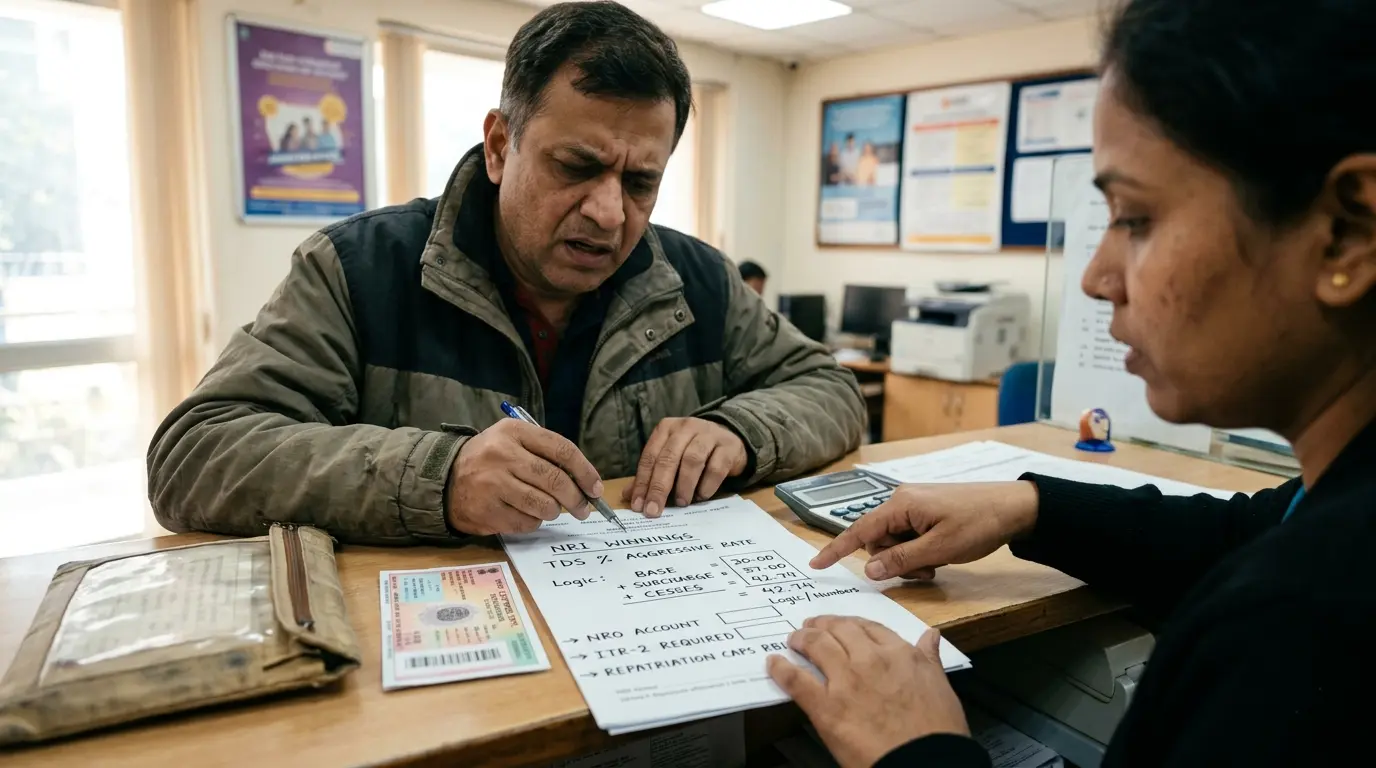
Are you an expat celebrating a surprise windfall from an Indian ticket or game? Before you plan how to repatriate those funds, you must understand the rules for nri lottery winnings tax in india, as the tax department treats overseas citizens with extreme structural severity. Most expats assume that standard domestic withholding rules apply equally to everyone, but a hidden compliance mechanism frequently catches non-residents off guard.

Therefore, mastering these specific regulations remains vital to protecting your capital from permanent loss. This cross-border clearing process operates under a completely different framework than resident rules.

To see how these international withholding systems tie back to the master compliance framework, read our pillar guide on Lottery Tax in India. Ignoring these distinct parameters can lead to the immediate blockage of your non-resident bank accounts.

📌 Key Takeaways

  • The Resident vs. NRI Split: First, while residents pay a flat 31.2% tax, non-residents face aggressive, variable surcharges deducted directly at the source.
  • Section 195 Aggression: Furthermore, deductors process expat windfalls under strict non-resident withholding rules, pushing the effective tax rate as high as 42.74%.
  • Zero DTAA Shielding: Consequently, Double Taxation Avoidance Agreements completely exclude windfall, lottery, and gambling profits from relief.
  • Filing Mandate: In addition, NRIs must file a specialized ITR-2 return using their temporary or non-resident status to manually reclaim any excess TDS.

The Non-Resident Framework for NRI Lottery Winnings Tax in India

The Indian tax framework evaluates cross-border windfall capital based on your physical presence during the financial year. Primarily, the state does not grant non-residents the basic tax exemptions or slab benefits available to local citizens.

The Intersection of Section 393 and Section 195

Under the updated Income-tax Act, 2025, all domestic lottery payouts are governed by Section 393. However, when the winner is a non-resident, the transaction must also pass through the compliance filters of Section 195.

Consequently, this intersection alters how the payout agent processes your money. Instead of applying a simple flat rate, the clearing entity must calculate withholding taxes based on the maximum potential tax rate for foreign entities. For a closer look at how these fundamental baseline rates are structured, check out our guide on Section 194B and Section 393 Layouts.

Tax Rates on NRI Lottery Winnings Tax in India

The primary compliance hazard for expats lies in the automated application of peak surcharges. Payers are legally required to protect themselves from penalties, which often leads them to over-withhold taxes on non-resident accounts.

Surcharge and Cess Escalations for Non-Residents

While a resident payer enjoys a flat 4% health and education cess, an NRI payout faces a multi-tiered surcharge roadmap. Depending on the total prize value, the system applies surcharges ranging from 10% to 37% directly at the source.

Prize Valuation ThresholdBase Tax RateApplied Surcharge RateFinal Effective TDS Rate
Up to ₹50 Lakhs30%0%31.20%
₹50 Lakhs to ₹1 Crore30%10%34.32%
₹1 Crore to ₹2 Crores30%15%35.88%
Above ₹2 Crores30%25% / 37%Up to 42.74%

As a result, an expat winning a major prize can lose nearly half of their total windfall before the cash ever hits an NRO or NRE account. To calculate exactly how these aggressive tiers will impact your specific prize amount, run your numbers through our comprehensive Lottery Tax Calculator India tool.

DTAA Exclusions and the Myth of Double Taxation Relief

Expat communities frequently share misleading advice regarding Double Taxation Avoidance Agreements (DTAA). Many believe these treaties will automatically shield them from being taxed twice on the same income.

Why Tax Treaties Fail to Protect NRI Lottery Winners

Primarily, global tax treaties are designed to protect active business profits and professional salaries rather than casual windfalls. Almost every DTAA signed by India completely excludes lotteries, card games, betting pools, and race rewards from mutual tax relief benefits.

Thus, you will likely pay full taxes in India at the source, and you may still face additional disclosure liabilities in your current country of residence. This strict rule mirrors the global standard applied to international players, which you can explore further in our analysis of Tax on Foreign Lottery Winnings in India.

Compliance and Refund Protocols for Expats

Recovering over-withheld funds from the tax department requires following a precise, sequential filing process. If you submit incorrect documentation, your application will be automatically rejected by the centralized portal.

How to Correctly File ITR-2 as an NRI

To legally reclaim excess surcharge allocations, you must file your annual return using Form ITR-2. Specifically, do not attempt to hide your expat status to bypass non-resident verification checks.

Step 1: Match Form 16A TDS logs with your Form 26AS ledger entries.
Step 2: Declare the gross prize value inside Schedule OS (Income from Other Sources).
Step 3: Compute the exact surcharge relief under foreign status verification scripts.

Furthermore, ensure your NRO bank account is fully pre-validated on the electronic filing platform. The system cannot process international wire transfers or non-resident refunds if your account validation status is pending. For formal verification of non-resident filing mandates, always review the updated structural guidelines on the Official Income Tax Department Portal.

Frequently Asked Questions

Is an NRI lottery win taxable in India?

Yes, any lottery win originating in India is fully taxable for NRIs. The income tax framework states that all windfall income earned within Indian borders is subject to immediate taxation, regardless of the winner’s current country of residence.

Why do NRIs pay higher TDS on lottery winnings?

NRIs face higher TDS rates because Section 195 requires payers to deduct both the base tax and the maximum applicable surcharges at the source. This requirement can push the final withholding rate as high as 42.74% for large prize amounts.

Can an NRI use DTAA to avoid Indian lottery tax?

No, NRIs cannot use DTAA provisions to avoid windfall taxes. Most international tax treaties signed by India explicitly exclude casual income, gambling winnings, and lottery prizes from double-taxation protection or relief benefits.

Which ITR form should an NRI use for lottery income?

An NRI must use Form ITR-2 to report lottery income and claim any eligible tax refunds. You must declare the total gross winnings inside Schedule OS while ensuring your non-resident bank details are fully validated for processing.

Can lottery winnings be deposited into an NRE account?

No, organizers cannot deposit local lottery winnings directly into an NRE account. The funds must first clear through an NRO account, where they remain subject to standard repatriation caps and RBI compliance checks.

Conclusion & Next Steps

In summary, managing the nri lottery winnings tax in india requires careful navigation of both Section 393 and Section 195 compliance rules. While the base tax rate remains fixed at 30%, hidden surcharge escalations can easily drain your cross-border windfall if left unmanaged.

Therefore, secure your official Form 16A certificates from the distributing agent as soon as possible. Additionally, make sure your cross-border accounting team reviews your Form 26AS ledger entries carefully before submitting an ITR-2 refund request.

Won a Foreign Lottery? India Still Taxes It

Reviewed for Accuracy by: Tax Compliance Editorial Board

Disclaimer: This guide provides strategic insights based on the architectural framework outlined in the tax-cluster-content-map.pdf document. It does not constitute formal legal or financial advice. Taxpayers must consult a qualified Chartered Accountant (CA) or verify rules against the latest Finance Act provisions before filing.

Many Indian residents celebrate winning a major global sweepstakes like the US Powerball or the Dubai Big Ticket without considering home-country tax laws. However, domestic compliance rules do not vanish when you win money outside geographic borders. Consequently, understanding the exact statutory mandates governing the tax on foreign lottery winnings in india remains absolutely vital for all global prize winners.

Therefore, studying these structured cross-border regulations helps players calculate their actual take-home wealth accurately. This international financial obligation operates alongside local clearing protocols. To see how these global rules mesh with domestic windfall frameworks, read our master Lottery Tax in India pillar page. If you fail to declare overseas windfalls correctly, the tax department can reject your annual submission entirely.

📌 Key Takeaways

  • Global Income Mandate: First, Resident and Ordinarily Resident (ROR) individuals must pay tax on all worldwide earnings, including overseas windfalls.
  • The Flat Rate: Furthermore, the government applies the standard flat 30% base rate plus a 4% cess, totaling an effective 31.2% tax liability.
  • No DTAA Relief: Consequently, Double Taxation Avoidance Agreements (DTAA) rarely protect casual gambling or lottery winnings from home taxation.
  • Severe Penalty Risk: In addition, omitting these overseas windfalls triggers massive concealment penalties under Section 271.

Global Income Rules for Tax on Foreign Lottery Winnings in India

The Indian tax framework evaluates your fiscal liability based on your formal residential status rather than the location of the prize pool. Primarily, the Income-tax Act categorizes individuals to determine global tax exposure.

Residential Status and Worldwide Tax Exposure

If you qualify as a Resident and Ordinarily Resident (ROR) for the financial year, the state taxes your global income. For example, it does not matter if a foreign lottery organization hosts the draw in New York, London, or Dubai.

Consequently, the tax authorities view the prize money as taxable income the moment it accrues to your global profile. However, the rules adapt differently if your residency shifts outside the country. For instance, you can compare these resident mandates with non-resident structures by reading our specialized guide on NRI Lottery Winnings Tax Rules.

How the Tax on Foreign Lottery Winnings in India Applies Globally

The government does not allow you to aggregate international windfalls with normal slab rates. Instead, the tax department applies a strict, flat rate directly to the gross windfall value.

First, you face the flat 30% baseline rate. Second, you must add the mandatory 4% health and education cess, which locks your effective domestic liability at 31.2%.

Furthermore, the law explicitly denies any standard deductions, baseline personal exemptions, or expenditure offsets against this windfall income. Thus, you cannot deduct the cost of purchasing the international ticket from your taxable winnings pool.

The Illusion of DTAA Relief for Tax on Foreign Lottery Winnings in India

Many global winners incorrectly assume that Double Taxation Avoidance Agreements (DTAA) will fully shield them from paying taxes twice. However, international tax treaties feature specific limitations regarding casual income.

Why Tax Treaties Fail to Protect International Lottery Gains

Primarily, most DTAA treaties signed by India exclude windfalls, lottery earnings, gambling rewards, and betting income from mutual tax relief benefits. For example, if the US Internal Revenue Service (IRS) withholds tax on a US Powerball prize at the source, the Indian tax department will still demand its full fiscal share.

As a result, you might suffer from severe double taxation unless a specific treaty clause permits a localized Foreign Tax Credit (FTC). Therefore, computing these potential cross-border shortfalls remains an essential defensive step. To quickly calculate what you owe after foreign withholdings occur, run your numbers through our updated Lottery Tax Calculator India tool.

Mandatory Disclosure and ITR Schedule FA Requirements

Concealing international prize money is an incredibly dangerous strategy under modern automated tracking networks. The tax department utilizes extensive data-sharing networks to spot unreported offshore wealth.

Navigating Schedule FA and Schedule FSI for Foreign Prizes

When filing your annual return, you must report your overseas sweepstakes earnings using specific documentation paths. Specifically, you must declare the income under Schedule FSI (Foreign Source Income). In addition, you must log any remaining offshore bank balances or assets under Schedule FA (Foreign Assets).

Step 1: Declare gross winnings inside Schedule FSI ──► Computes home liability
Step 2: Disclose overseas bank accounts in Schedule FA ──► Ensures full compliance

If you skip these vital disclosures, the tax department can levy severe penalties under Section 271 of the Income-tax Act. Furthermore, the government can initiate harsh compliance audits for holding undisclosed foreign assets. For formal verification of current international reporting structures, always review the electronic filing manuals on the Official Income Tax Department Portal.

Frequently Asked Questions

Is a foreign lottery win taxable in India?

Yes, a foreign lottery win is fully taxable in India if you qualify as a Resident and Ordinarily Resident (ROR). The Income-tax Act requires residents to pay tax on all worldwide income, regardless of where the fund originates.

How is a US Powerball or Dubai prize taxed in India?

The Indian government taxes a US Powerball or Dubai Big Ticket prize at a flat base rate of 30% plus a 4% cess, creating an effective tax rate of 31.2%. This tax applies to the gross amount before any personal expense deductions.

Does DTAA reduce tax on foreign lottery winnings?

No, DTAA provisions rarely reduce tax on foreign lottery winnings. Most international tax treaties signed by India exclude casual incomes like lotteries, gambling, and betting from double-taxation relief benefits.

Do I report foreign winnings as foreign assets?

Yes, you must report foreign winnings as foreign assets if you retain the cash prizes in an overseas bank account. You must declare these balances in Schedule FA (Foreign Assets) during your annual return filing.

What if the foreign country already withheld tax?

If the foreign country already withheld tax at the source, you must still declare the gross earnings in India. You can only claim a Foreign Tax Credit (FTC) if the specific tax treaty allows relief for casual gaming income.

Conclusion & Next Steps

In conclusion, managing the tax on foreign lottery winnings in india requires total transparency and meticulous reporting. The domestic tax department will enforce its 31.2% claim on your global windfalls regardless of where the draw takes place.

Therefore, before attempting to repatriate any global prize money, gather all international withholding certificates. In addition, ensure your filing team accurately logs the windfall inside Schedule FA and Schedule FSI to prevent devastating statutory penalties.

Lottery GST: You Pay 28% Before You Even Win

Reviewed for Accuracy by: Tax Compliance Editorial Board

Disclaimer: This article provides informational context regarding the tax-cluster-content-map.pdf structure and does not constitute formal financial advice. Please consult a certified Chartered Accountant (CA) or review the latest statutory notifications from the Ministry of Finance before making financial decisions.

When purchasing a ticket in any state-authorized draw, understanding the total cost of gst on lottery tickets in india remains crucial. Many lottery buyers fail to realize that a major fiscal loss hits their pockets before the draw even occurs. Specifically, the government claims a massive portion of your money directly at the retail counter. Consequently, you encounter the heavy drag of indirect taxation immediately during the transaction.

Therefore, studying these structured legal rules helps players calculate their true mathematical returns accurately. This hidden expense operates completely independently from the final prize distribution rules. To see how these manufacturer-level levies interact with backend liabilities, read our master pillar page. If you ignore this upfront fee, your calculations for net asset profitability will fail completely.

📌 Key Takeaways

  • The Upfront Rate: First, the government enforces a uniform 28% GST rate on all lottery ticket transactions across the country.
  • Baked-In Pricing: Furthermore, authorized distributors build this tax directly into the face value of the ticket.
  • No Refunds: Consequently, players can never recover or claim a refund for the GST paid on a losing ticket.
  • Double Taxation: In addition, winners must pay both the 28% indirect ticket tax and the 31.2% direct income tax on any prize money.

Core Mechanics of GST on Lottery Tickets in India

The structural cost framework under the national Goods and Services Tax (GST) system treats lotteries strictly as actionable claims. Consequently, the GST Council applies its highest tax bracket to these specific gaming transactions.

How Distributors Compute GST on Lottery Tickets in India Upfront

Primarily, the state does not add this tax at the billing register as an extra line item. Instead, organizers bake the gst on lottery tickets in india directly into the printed retail price of the card.

For example, if you buy an official ticket for ₹100, you are not deploying the full ₹100 toward the underlying prize pool. Rather, approximately ₹21.88 of that initial purchase goes directly to the state treasury immediately.

Therefore, the actual mathematical value of your play drops sharply before the numbers lock in. You can easily compute your remaining net asset values using our updated tool.

Supreme Court Rulings on GST on Lottery Tickets in India

Historically, different states attempted to charge varying tax rates based on whether they ran or merely authorized the lottery scheme. However, intense legal battles eventually forced a unified national standard across all jurisdictions.

Why the Supreme Court Upheld the 28% GST on Lottery Tickets in India Rate

The highest court resolved this long-standing debate by ruling that lotteries constitute a clear form of gambling and luxury consumption. Specifically, the justices clarified that the parliament holds full constitutional powers to tax actionable claims at maximum rates.

Consequently, this landmark judgment standardized the tax rate across every single region. Whether you buy a paper ticket from a state-run program or participate in an authorized regional draw, the 28% rule applies universally.

Notably, this structure differs completely from modern digital sports games. Those online gaming platforms navigate entirely distinct regulatory codes like Section 194BA and Section 115BBJ, as highlighted in our breakdown of .

Double Taxation Myths: Ticket GST vs. Winnings Income Tax

Taxpayers often complain that this dual-layered framework represents illegal double taxation. However, the legal architecture treats these mechanisms as two completely separate fiscal events under the law.

Step 1: Buy Ticket ──► 28% GST (Indirect Tax on Consumption)
Step 2: Win Prize   ──► 31.2% Income Tax (Direct Tax on Winnings)

First, you pay an indirect consumption tax when buying the physical ticket. Second, you face a direct income tax if that ticket actually wins a cash reward.

Thus, the government collects revenue from both the transaction itself and the resulting windfall wealth. To protect your capital from further automated compliance actions during this second phase, make sure to review our comprehensive guide on avoiding an unexpected notice via proper filing. For official legal verifications, always reference the updated schedules on the .

Frequently Asked Questions

Is GST charged on lottery tickets in India?

Yes, the government charges GST on every single lottery ticket sold within the country. According to the statutory frameworks detailed in the architectural mapping data from the tax-cluster-content-map.pdf, this indirect tax applies right at the point of initial sale.

What is the GST rate on lottery tickets?

The current statutory rate stands at a flat 28%. Organizers compute this percentage against the face value of the ticket or the price notified in the official gazette, choosing whichever amount is higher.

Do I pay GST and income tax on the same lottery?

Yes, you effectively pay both taxes through different stages of the process. You pay the 28% GST upfront when purchasing the ticket, and you pay an effective 31.2% income tax on any winnings later.

Can I claim a refund of GST on a losing ticket?

No, you cannot claim a refund under any circumstances. The tax laws treat the upfront GST as a final consumption tax on the purchase transaction, meaning the money is permanently gone even if your ticket wins nothing.

Does GST apply to the prize money or only the ticket?

The 28% GST applies strictly to the transaction value of the ticket itself. It does not apply to the final payout pool. Instead, the government taxes the actual prize money via direct withholding codes at the effective 31.2% rate.

Conclusion & Next Steps

In conclusion, the 28% tax penalty on lottery ticket purchases represents an unavoidable structural reality in India. This tax cuts into your play equity long before the official draw takes place.

Therefore, always double-check the face value calculations on your receipts. In addition, ensure your accounting strategies accurately separate these retail ticket expenses from your final annual income tax filing schedules.

194B Is Gone: Lottery Tax Under the 2025 Act

The transition to the new fiscal era brings massive structural updates that every tax professional and lottery winner must master. The legislature has officially retired Section 194B. The freshly enacted Income-tax Act, 2025 completely restructures how authorities track windfall income, shifting the entire mechanism to a new legal code. If you reference the obsolete section code on your upcoming tax return, the central processing system will automatically reject your filing.

To file your returns without errors, you must understand how the updated Lottery Tax in India: The 31.2% Rule Winners Miss operates under this rewritten statutory framework. While your core financial liability remains unchanged, the legal mechanics require a completely fresh compliance approach. Let’s break down the essential statutory changes mapping out your tax obligations for the current assessment period.

Key Takeaways

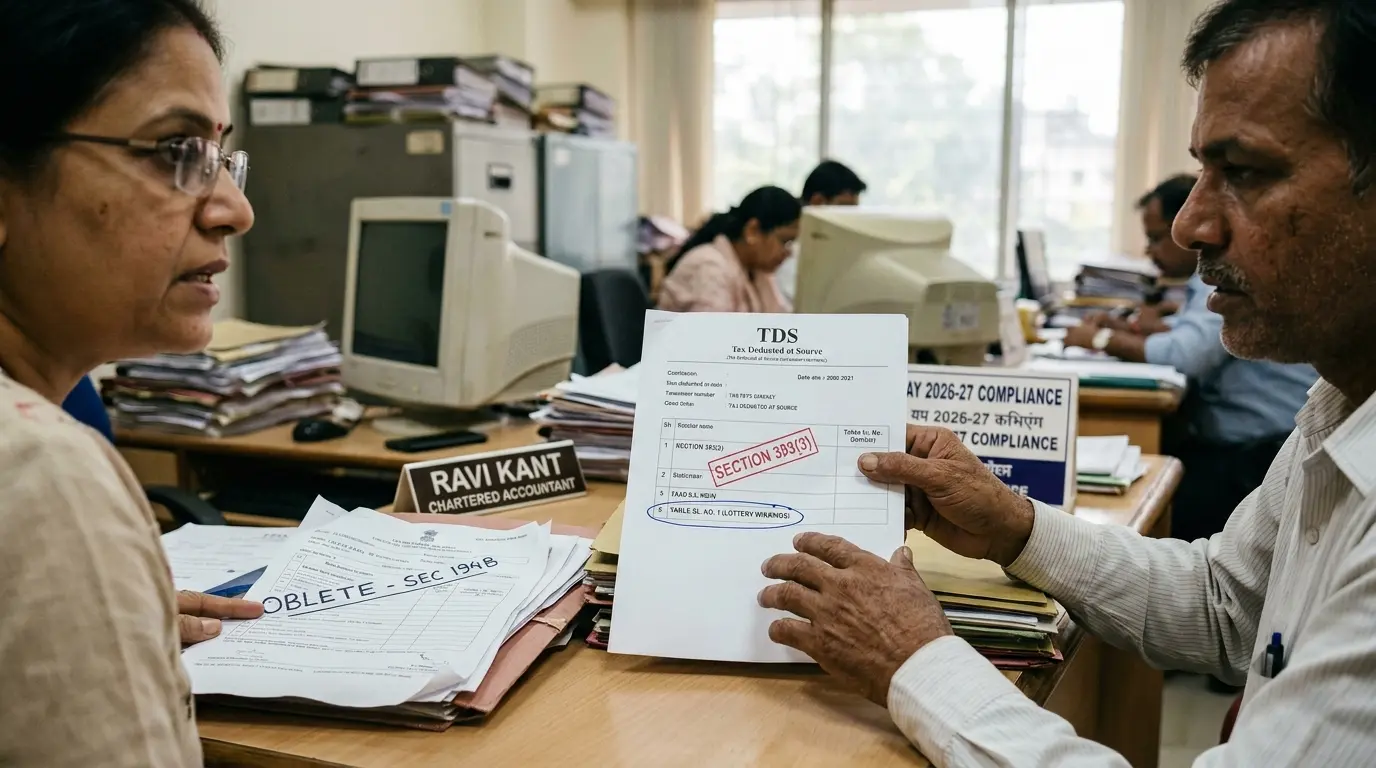
  • Statutory Renumbering: The Income-tax Act, 2025 officially replaces the legacy Section 194B with the newly minted Section 393(3) effective April 1, 2026.
  • Identical Tax Rates: The structural reorganization alters the section numbers but maintains the flat 30% base tax and 4% cess layout.
  • Threshold Preserved: The ₹10,000 tax deduction threshold survives the transition, applying strictly to individual transactions.
  • Filing Mandatory: Taxpayers must utilize the updated Section 393 citations when completing their AY 2026-27 tax forms to prevent immediate processing errors.

Decoding Lottery Tax Under Section 393: What Has Changed?

The Structural Sunset of Section 194B

For decades, taxpayers tracked lottery withholdings exclusively through Section 194B. However, the legislative overhaul taking full effect on April 1, 2026, completely retires this familiar code. The government introduced the Income-tax Act, 2025 to clean up historical layers of amendments, consolidating varied windfall codes into streamlined chapters.

Under this new architecture, the old section vanishes entirely from active filing procedures. Administrators now track all domestic lottery payouts through the newly codified provisions. You can read the official announcement and track statutory updates directly on the Income Tax Department of India portal.

Old vs New Section Mapping for 2026

The legal update extends beyond a single line item. The legislature has systematically remapped the entire framework that governs speculative income, prize draws, and withholding duties. This structural shift alters the labels across your entire tax ledger.

The transition leaves no legacy codes behind for traditional paper games. To keep your books accurate, review this official structural shift:

  • Legacy TDS Withholding: Section 194B shifts directly into Section 393(3).
  • Legacy Charging Provision: Section 115BB transitions into its new counterpart under the 2025 Act.
  • Legacy Expense Disallowance: Section 58(4), which blocks expense claims against winnings, maps to a new restrictive clause.

Key Operational Rules Preserved Under Section 393

The Survival of the Per-Transaction Threshold

Many taxpayers worry that a new law means the total elimination of basic tax thresholds. Fortunately, the foundational ₹10,000 threshold survives this major legislative revamp intact. The tax department retains the updated per-transaction standard established during the previous fiscal year.

This means ticket agents and state distributors calculate your liability on individual payouts rather than your seasonal tournament accumulation. To explore how this mechanism filters multiple ticket wins, review our complete breakdown of the lottery TDS 10,000 threshold rules.

Tax Rates and Cess Maintenance

While the code names change, the underlying financial math remains completely steady. The government has not used this reorganization to secretly increase your tax bill. Winnings face the same flat 30% base rate alongside the mandatory 4% health and education cess.

This ensures your real-world liability holds flat at a total 31.2% tax rate. If you want to differentiate this traditional structure from digital formats, read our guide explaining why online game winnings tax vs lottery protocols utilize entirely different calculation pathways.

Impact on Filing Your AY 2026-27 Winnings Tax Return

Avoiding Automated ITR Defect Notices

The central tax processing utility uses automated algorithms to screen inbound data against pre-compiled employer and distributor records. If your filed ITR claims a credit using the obsolete 194B designation for a transaction finalized after April 1, 2026, the software triggers an immediate error flag.

The system treats this variation as an invalid credit claim, halting your assessment and dispatching an automated defect notice. You must verify that your accountant updates their software presets to reflect the new legislative codes.

Verifying Section 393(3) Table Sl. No. 1

When you receive your formal tax deduction certificates from state lottery boards, check the statutory declarations carefully. Valid certificates issued for recent draws must explicitly reference Section 393(3) Table Sl. No. 1 to clear processing checks.

Cross-reference these entries against your updated Annual Information Statement (AIS) before submitting your final data packet. If any legacy labels appear on your forms, request an immediate corrected statement from the issuing distributor.

Frequently Asked Questions About Lottery Tax Under Section 393

Legislative and Code Change FAQs

Is Section 194B still valid in 2026?

No, Section 194B is no longer valid for transactions taking place after April 1, 2026. The newly introduced Income-tax Act, 2025 has completely retired the code, replacing it with updated statutory sections for all current windfall earnings.

What replaced Section 194B under the Income-tax Act 2025?

Section 393(3) officially replaces Section 194B under the new legislative framework. This updated code now governs the entire Tax Deducted at Source (TDS) mechanism for lottery prizes, lucky draws, and crossword windfalls across India.

From when does Section 393 apply to lottery winnings?

Section 393 applies officially to all lottery winnings distributed on or after April 1, 2026. Any prize distributed after this launch date falls strictly under the regulatory mandates of the new Income-tax Act, 2025.

Did the lottery TDS rate change under the new Act?

No, the lottery TDS rate did not change under the new Act. The base withholding rate remains fixed at exactly 30%, which combines with the 4% education cess to create an effective 31.2% tax rate.

What is Section 393(3) Table Sl. No. 1?

Section 393(3) Table Sl. No. 1 is the exact statutory line item that mandates tax deductions on lottery prizes. State departments use this specific sub-clause to validate their formal withholding actions when paying out windfalls.

Filing and Threshold FAQs

Should I cite 194B or 393 in my AY 2026-27 ITR?

You must cite Section 393 in your AY 2026-27 ITR for all earnings realized after the new law took effect. Inputting the outdated 194B code will confuse the automated system and trigger a defective return notice.

Did the 10,000 threshold survive the 2025 change?

Yes, the ₹10,000 threshold survived the legislative transition completely intact. The tax department continues to apply this exemption limit on an individual per-transaction basis rather than tracking an aggregate annual total.

Are old TDS certificates referencing 194B still valid?

Old TDS certificates referencing 194B remain valid only if they cover financial transactions completed prior to April 1, 2026. You can use them to defend historic filings or handle unresolved back-year assessments.

Which sections replaced 115BB and 58(4)?

The Income-tax Act, 2025 replaced Section 115BB with a modernized charging clause, while Section 58(4) shifted into a parallel expense restriction rule. These new lines replicate the old absolute ban on deductions.

Where can I verify the new section mapping officially?

You can verify the official section mapping by accessing the complete text of the Income-tax Act, 2025 on the Gazette of India electronic repository or by browsing the primary concordance tables uploaded to the central tax e-filing portal.

Conclusion & CTA

Adapting to structural tax changes ensures you keep your financial life free from unnecessary state legal entanglements. The transition from Section 194B to Section 393 alters the filing labels completely, making proactive software updates an absolute necessity for compliance. Review your financial records, confirm your withholding codes with your lottery distributor, and use the updated legal citations to process your returns smoothly without triggering automated processing faults.

Lottery Tax in India: The 31.2% Rule Winners Miss


Many lottery ticket buyers spend time dreaming of a life-changing windfall, but few understand the immediate tax reality that follows. A major prize triggers a strict tax mechanism that operates completely outside standard income brackets. If you are analyzing a potential windfall, understanding the tax on lottery winnings in India serves as your first line of financial defense.

Failing to account for these specific regulations often leads to severe penalties and compliance notices from the Income Tax Department. The rules offer no room for standard tax-saving strategies. Let’s break down the exact mathematics and statutory rules governing windfall gains in 2026.

Key Takeaways

  • Flat Tax Rate: The government applies a flat 30% tax plus a 4% cess to all lottery winnings, establishing a 31.2% effective tax rate from the first rupee.
  • No Slab Benefits: The tax department ignores your regular progressive personal income tax slabs when taxing winnings.
  • Zero Deductions: You cannot claim standard deductions, Section 80C investments, or basic exemption limits against this income.
  • Section 393 Transition: Effective April 1, 2026, the new Income-tax Act, 2025 officially renumbers Section 194B to Section 393(3).
  • Per-Transaction TDS: Authorities apply the ₹10,000 TDS threshold strictly per single transaction rather than an annual aggregate.

Understanding Tax on Lottery Winnings in India: The 31.2% Rule

How Flat Rate Winnings Tax Ignores Income Slabs

The Income Tax Department does not treat your prize as regular salary, business revenue, or interest. Instead, windfall income falls under a special regime that enforces a strict flat rate winnings tax. Your current personal income tax slab makes zero difference to the final calculation.

Whether you earn no other income or sit in the highest tax bracket, you pay the exact same base tax rate on the prize. This ensures the government captures every single rupee uniformly under specific windfall provisions.

Calculating the 30% Tax and 4% Cess on Lottery Winnings

The Income-tax Act sets the base statutory tax rate applied to windfall income at exactly 30%. To find your total real-world liability, you must calculate a 4% health and education cess directly on top of that base tax rate.

This mathematical combination creates the absolute 31.2% lottery tax rate that catches many unprepared winners off guard. Large jackpots may also trigger additional surcharges, further reducing your actual take-home amount. Read more about this in our legacy guide: 1 Crore Lottery Prize: Why You Take Home Only 68.8 Lakh. You can also verify the current official cess rates directly on the Income Tax Department of India website.

Why Deductions Fail Against Tax on Lottery Winnings in India

Section 80C and 80D Limits

Taxpayers often rely on popular investment channels to legally reduce their annual tax obligations. However, Section 58(4) of the Income-tax Act explicitly blocks you from using these relief mechanisms for windfall gains.

You cannot use investments in PPF, ELSS, or life insurance under Section 80C to lower your lottery liability. Medical insurance premiums filed under Section 80D similarly fail to offset this specific income stream.

The Ban on Basic Exemption Limits and Loss Set-Offs

If your regular total annual income falls below the basic exemption threshold, you normally pay no income tax. However, the tax code explicitly removes this basic exemption limit when calculating tax on lottery earnings.

Furthermore, you cannot offset business losses or capital losses against your winnings. The law even prevents you from deducting the money you spent purchasing losing lottery tickets from your winning prize amount. Discover more about whether you can set off losses against lottery winnings.

Section 393: The 2026 Shift for Lottery Tax in India

Income-tax Act, 2025 Renumbering Details

A major compliance update takes full effect for the fiscal year starting April 1, 2026. The freshly enacted Income-tax Act, 2025 systematically reorganizes historical tax codes to streamline administration.

Through this transition, the government renumbered the long-standing section 194B. The new legislative framework formally designates it as Section 393(3). You can read our detailed breakdown of lottery tax under Section 393.

The New Per-Transaction Lottery TDS Threshold

The mechanism for Tax Deducted at Source (TDS) maintains a specific statutory safeguard. Since April 1, 2025, the government applies the mandated ₹10,000 threshold entirely to a single transaction.

This per-transaction rule ensures clarity for distributors withholding lottery TDS India balances. If a single ticket payout stays below ₹10,000, the distributor does not withhold immediate TDS, though you must still pay tax on the underlying amount. Learn more about the lottery TDS 10,000 threshold.

Reporting Lottery Income: Filing Your ITR Correctly

You must explicitly file the windfall under the correct classification. The tax department requires you to report lottery winnings under the head “income from other sources”. Failing to specify this correctly prompts the automated processing system to flag a mismatch. The tax department’s system instantly cross-references your disclosures against incoming TDS records.

You cannot file a basic ITR-1 form if you possess any form of windfall or lottery income. Instead, you must utilize the more comprehensive ITR-2 form. You ensure full compliance by accurately entering the values into the designated schedules. If you miss this step or choose the wrong form, the tax department will quickly send an official tax notice.

Online Game Winnings Tax vs Lottery Tax in India

While both involve elements of chance, online gaming operates under a completely separate tax structure. Online platforms follow Section 115BBJ and Section 194BA to govern their operations.

Unlike paper lotteries, online gaming tax focuses strictly on net winnings rather than gross single transactions. Furthermore, online games carry no baseline threshold limit for TDS withholding. Check out our guide on why Dream11 tax isn’t the same as lottery tax.

To calculate your accurate take-home income for either category, we highly recommend using an optimized lottery tax calculator India. You can also verify the detailed online gaming tax circulars directly via the Central Board of Direct Taxes (CBDT) official portal.

Frequently Asked Questions About Tax on Lottery Winnings in India

Rates and Deductions FAQs

How much tax do I pay on lottery winnings in India?

You pay an effective tax rate of 31.2% on lottery winnings in India. You calculate this by combining a flat base tax rate of 30% with a 4% health and education cess. Higher prize amounts may also attract additional surcharges.

Is lottery income taxed at my income tax slab rate?

No, the government never taxes lottery income at your standard personal income tax slab rate. You pay a fixed, flat tax rate from the very first rupee, regardless of your other annual earnings or brackets.

Are lottery winnings below 10,000 taxable?

Yes, you must pay tax on lottery winnings below ₹10,000. While distributors do not deduct TDS on individual payouts below this threshold, you remain legally required to report and pay tax on the income in your ITR.

Can I claim 80C deductions against lottery winnings?

No, you cannot claim Section 80C deductions against lottery winnings. Section 58(4) of the Income-tax Act strictly prohibits you from using any chapters or investment deductions to reduce your overall tax liability on windfall income.

Filing and Compliance FAQs

Under which head is lottery income reported in the ITR?

You must report lottery income under the head “Income from Other Sources” in your Income Tax Return. You must declare it in the specific quarterly breakdown schedules provided within the tax filing form.

What is the effective tax rate after cess on a prize?

The effective tax rate after you add the 4% health and education cess is exactly 31.2%. The government applies this combined rate globally across India to all forms of lottery, card games, and betting windfalls.

Do I pay extra tax if TDS was already deducted?

You may owe extra tax if your total prize money triggers mandatory surcharges. Additionally, if you miss advance tax deadlines during the financial year, you might face interest charges under Sections 234B and 234C.

Is the basic exemption limit available against winnings?

No, the government completely removes the basic exemption limit when you calculate tax against lottery winnings. Even if you have zero other income for the year, your entire lottery prize remains taxable at the flat 31.2% rate.

Which ITR form do I file after winning a lottery?

You must file using the ITR-2 form after winning a lottery. You cannot use the basic ITR-1 form to declare windfall income, as it lacks the necessary schedules for disclosure.

What happens if I don’t declare lottery winnings?

If you fail to declare lottery winnings, the income tax department will penalize you with severe fines and automated compliance notices. The system cross-references your ITR with incoming TDS data, penalizing undisclosed windfalls under concealment rules.

Conclusion & CTA

Navigating a major lottery win involves more than just managing sudden wealth; you must meet strict financial obligations. With the introduction of the Income-tax Act, 2025 and the shift to Section 393, you must prioritize compliance more than ever. Ensure you document your prize correctly, file the proper forms, and account for the full 31.2% tax liability to protect your winnings from unnecessary penalties.

Why Dream11 Tax Isn’t the Same as Lottery Tax

Online Game Winnings Tax vs Lottery: Why Dream11 Is Different

Reviewed for accuracy by AgileWoW Tax Team | Last Updated: June 2026 Disclaimer: This content is informational, not tax advice; verify with a CA or the latest Finance Act.

When comparing online game winnings tax vs lottery regulations, the flat 30% rate makes them look identical. However, the rules diverge sharply under Section 194BA. Many taxpayers assume income tax treatments interchange perfectly because both activities involve chance or skill-based rewards. Misread this distinction, and you will break your ITR.

If you have already reviewed our comprehensive guide explaining how India calculates tax on lottery winnings, you know the traditional rules. However, fantasy sports and rummy apps operate under an entirely different legislative framework. Navigating Dream11 tax in India requires understanding specific deductions, distinct TDS sections, and an entirely separate set of compliance obligations.

Key Takeaways

  • Different Regimes: Section 194B covers traditional lotteries, while a separate regime under Section 194BA governs online games.
  • Net vs. Gross: Section 115BBJ taxes online games on net winnings. Traditional lottery tax hits the gross payout.
  • Zero Threshold: Online games have no threshold for TDS; the system tracks every rupee of net winning.
  • Act Transitions: The new Income-tax Act, 2025 renumbers the classic Section 194B to Section 393(3) starting 1 Apr 2026.

The Illusion of the 31.2% Flat Rate

At first glance, the tax structures seem like twins. Both traditional lottery payouts and online gaming winnings attract a heavy base tax rate. Lottery winners pay a flat 30% tax plus a 4% cess, resulting in an effective tax rate of 31.2%. Furthermore, taxpayers owe this amount regardless of their personal income slab.

Because the final percentage matches perfectly, millions of players copy-paste their tax assumptions from one column to the other. They assume the exact same rules apply if they play online rummy or build a fantasy cricket team. This mistake creates a costly compliance error.

While the rate matches, the tax authorities completely separate the taxable base and the deduction mechanics. Relying on outdated lottery rules for a modern gaming portfolio inevitably triggers a Form 26AS mismatch and subsequent scrutiny.

Online Game Winnings Tax vs Lottery: The Core Section 194BA Differences

The fundamental divide between these two income streams comes down to their governing sections. Section 194B of the Income-tax Act 1961 dictates traditional lottery TDS. However, be aware that from 1 Apr 2026, the Income-tax Act, 2025 renumbers 194B as Section 393(3).

Online gaming occupies its own dedicated ecosystem. Section 194BA exclusively handles the Tax Deducted at Source (TDS) for online games. Lawmakers introduced this section specifically to capture the high-frequency, digital nature of platforms like Dream11, bringing fantasy sports under a specialized compliance umbrella. The CBDT Circular 5/2023 officially outlines and enforces these modern rules.

How Net Winnings Impact Online Game Winnings Tax vs Lottery

The most critical divergence centers on how the law calculates the taxable amount. Under traditional lottery laws, you pay tax on the gross prize. The law allows no deductions and permits no set-offs.

Section 115BBJ operates differently for online games, specifying a tax on net winnings. This means the platform calculates your total withdrawals, subtracts your total deposits, and applies the tax only to the actual profit.

This net-winnings approach provides a slight buffer for regular players. It acknowledges the continuous deposit-and-withdrawal loop typical of fantasy sports ecosystems. Consequently, you do not pay tax on your own capital recycling through the app.

The Disappearance of the ₹10,000 Threshold

If you win a traditional state lottery, the payout triggers TDS only if the prize crosses a specific line. From 1 Apr 2025, the ₹10,000 threshold for traditional lotteries applies per single transaction.

Online gaming under Section 194BA offers no such breathing room. The law mandates absolutely no threshold for online gaming net winnings. Whether you net ₹50 or ₹50,000, the gaming platform must legally calculate and deduct the tax at the end of the financial year, or at the time of withdrawal.

Reporting Online Gaming TDS in Your ITR

Failing to report this correctly invites immediate tax notices. Your Annual Information Statement (AIS) will clearly categorize Dream11 and similar app deductions under Section 194BA.

If you file your return and casually dump this income into the general pool under the old Section 194B framework, the automated processing system flags the discrepancy. You must use the correct ITR schedules specifically designated for Section 115BBJ.

If you remain unsure how to correctly structure these specific fields during tax season, review the detailed steps in our legacy guide on navigating the ITR-2 after a lottery win. Proper classification ensures your TDS credits align perfectly with your declared tax liability.

Frequently Asked Questions

Tax Rates and Thresholds for Games

1. Is Dream11 winnings tax the same as lottery tax? No. While both effectively apply a 31.2% rate, Section 115BBJ taxes Dream11 on net winnings. The law taxes lotteries on the gross prize.

2. What is the difference between Section 194B and 194BA? Section 194B dictates TDS for traditional lotteries with a per-transaction threshold. Section 194BA governs online gaming platforms and taxes net winnings with no threshold.

3. Is there a 10,000 threshold for online game TDS? No, online games under Section 194BA have no threshold. Tax applies to every rupee of net winning.

4. Do Section 115BB or 115BBJ tax online winnings? Section 115BBJ strictly taxes online game winnings. Traditional lotteries fall under Section 115BB.

5. Does the law treat fantasy sports income as lottery winnings? No, the Income Tax Act classifies fantasy sports as online games. They fall under the entirely separate regime of 115BBJ and 194BA.

Calculating and Reporting Your Winnings

6. How do you calculate net winnings from online games? You calculate net winnings by taking withdrawals, subtracting deposits, and deducting any opening balance. The platform applies tax strictly to your actual profit.

7. Do deposits and bonuses count toward online game tax? The formula subtracts your own deposits when calculating net winnings. However, you must typically factor withdrawable platform bonuses into your taxable profit.

8. Why does my AIS show 194BA TDS I didn’t expect? Because the law provides no minimum threshold for online games, platforms must automatically deduct TDS on any net positive balance at the end of the financial year.

9. Can I set off online gaming losses against winnings? You cannot set off gaming losses against other separate income sources. However, the net winnings calculation inherently offsets your gaming losses within that platform against your wins. Traditional lottery winnings allow no set-off at all.

10. How do I report online game winnings in my ITR? Report them strictly within the tax schedule for Section 115BBJ. This ensures they match the Section 194BA entries reported in your AIS.

Conclusion

Treating online game winnings tax vs lottery income as identical is an outdated strategy that leads to compliance failure. By understanding the protective mechanics of net winnings under Section 115BBJ and the strict zero-threshold reporting of Section 194BA, you ensure a seamless tax filing experience. Always verify your AIS to match the exact sections before you submit your final ITR.

lottery-tax-itr

Lottery Tax Calculator India 2026: Net Prize in Seconds

Interactive lottery tax calculator India 2026 showing exact prize tax deductions

Have you ever wondered about your exact prize payout? Using a reliable lottery tax calculator India 2026 is absolutely essential today. First, calculating your final take-home money prevents sudden financial surprises. Furthermore, the math behind these government deductions seems complex initially. However, we simplify the entire process for you right here. Readers will learn exactly how tax laws logically impact their winnings. Consequently, you can confidently calculate your net payout in seconds. Additionally, we explore surcharges and the mandatory national health cess. Therefore, you will stay compliant with strict national tax regulations. Let us dive into the precise mechanics of prize taxation. Proper financial literacy protects you from unexpected government tax notices. Ultimately, understanding these numbers brings absolute peace of mind.

Why You Need a Lottery Tax Calculator India 2026

Understanding your tax liability is crucial for long-term financial planning. Initially, you might incorrectly think you keep the whole prize. Unfortunately, the government applies strict tax deductions at the source. Thus, an accurate net prize after TDS calculator helps immensely. For instance, winning large money triggers immediate and heavy tax obligations. Moreover, the Income Tax Act mandates these specific flat mathematical rates. Therefore, estimating your in-hand lottery prize amount becomes critically important. We built this comprehensive educational guide to clarify the entire process. Next, we will break down the fundamental national tax rules clearly. You must know these facts before checking your final bank account. Financial education remains your strongest asset in these specific situations. Let us explore the exact laws governing these mandatory fiscal deductions.

The Core Mechanics of the Section 194B Calculator

The national government regulates prize money through specific tax sections. First, Section 115BB imposes a flat thirty percent base tax legally. Subsequently, Section 194B mandates tax deduction directly at the payout source. This means the distributor cuts the tax before paying you. Consequently, a Section 194B calculator shows exactly what disappears instantly. Furthermore, this base rate applies to all large prize tiers equally. However, other layers like mandatory surcharges can complicate the final math. Therefore, using an automated mathematical tool saves you valuable time. Indeed, manual calculations often lead to highly stressful tax filing errors. Let us examine how the system mathematically processes your financial numbers. Proper knowledge prevents you from spending money you do not possess. Always verify your calculations before making any large personal financial commitments.

Use this interactive mathematical tool to understand your exact tax deductions. First, enter your gross prize value into the designated input field. Then, observe how the standard tax rates affect your final payout.

Show me the visualisation

How to Use the 1 Crore Lottery Tax Calculator

Winning a massive prize changes your financial life entirely overnight. However, a larger prize introduces a completely new taxation layer. Specifically, the government adds a surcharge on truly massive prize amounts. Therefore, a 1 crore lottery tax calculator becomes absolutely necessary. First, the standard flat tax still applies to your total winnings. Next, a ten percent surcharge hits the calculated base tax amount. Consequently, your take-home amount drops significantly below initially expected figures. We want you to understand this mathematical reality completely beforehand. Furthermore, proper financial literacy protects your newfound wealth securely always. Let us explore the math for smaller, yet highly substantial, regional prizes. Awareness of these specific surcharges prevents massive disappointment during prize collection. Please check our detailed surcharge on 1 crore lottery prize guide.

Exploring the 50 Lakh Lottery Tax Calculator

Prizes below one crore face slightly different mathematical tax rules. For example, a 50 lakh lottery tax calculator shows no surcharge. Thus, your manual math remains much simpler at this specific tier. The national government only applies the base tax and education cess. Therefore, your effective tax rate stays exactly at 31.2 percent. First, you calculate thirty percent of the fifty lakh rupees. Then, you add a four percent cess on that specific tax. Consequently, you understand your exact in-hand lottery prize amount easily. Always remember to check Section 194B rules for recent legislative updates. Education remains your absolute best defense against common tax calculation confusion. Next, we will comprehensively discuss calculating your final payout amount precisely.

Calculating the In-Hand Lottery Prize Amount Correctly

Every single winner wants to know their final bank deposit amount. Therefore, finding your true in-hand lottery prize amount is our primary goal. First, you start with the gross prize from your physical ticket. Next, you mathematically subtract the mandatory tax deduction at the source. Furthermore, our lottery tax calculator India 2026 does this calculation instantly. You never have to guess your final cash payout figure ever again. Similarly, understanding this math helps you plan your financial future responsibly. Many winners tragically struggle simply because they ignore these basic tax facts. We strongly encourage proactively learning the mechanics of these specific deductions. Let us look closely at local regional lottery market variations next. Regional differences absolutely do not change the core national taxation rules.

Lottery Sambad and Regional Prize Math Variations

Regional state lotteries strictly follow the exact same national tax laws. First, checking your numbers requires knowing these basic rules completely. Consequently, any prize exceeding ten thousand rupees faces immediate tax deduction. Furthermore, checking our Lottery Sambad Guide provides helpful regional context easily. The national government fully controls the tax rates, not individual state operators. Therefore, an accurate net prize after TDS calculator works perfectly everywhere. Similarly, the underlying math remains completely identical in Kerala, Nagaland, or Punjab. We strongly prioritize factual education across all regional lottery markets uniformly. Next, we will systematically explore the importance of annual tax return filing. Proper documentation definitively proves your compliance to the national tax department. Let us deeply discuss the specific government forms you need to succeed.

Managing Your Tax Through Proper ITR Filing Procedures

Calculating your exact tax is only the first important step. Afterwards, you must accurately report this income to the national government. Therefore, filing your Income Tax Return correctly is absolutely vital. First, winners must strictly use the specific ITR-2 form every single year. Furthermore, you legally declare these winnings under Income from Other Sources. Consequently, entirely avoiding this necessary step leads to serious legal penalties. We highly recommend reading our Lottery Tax & ITR Filing Guide thoroughly. Always consult a certified chartered accountant for personalized tax filing advice. Ultimately, staying legally compliant keeps your remaining prize money completely safe. Let us review the mandatory health and education cess details very closely. These seemingly small percentages significantly alter your final bank account deposit.

Adding the Health and Education Cess on Payouts

The standard base tax rate never tells the whole financial story. Indeed, the federal government mandates a special health and education cess. Therefore, this four percent charge applies directly to your base tax. First, calculate the thirty percent flat tax on your total prize. Next, correctly calculate four percent of that specific calculated tax amount. Consequently, this precisely creates the effective 31.2 percent standard national rate. A good Section 194B calculator handles this specific mathematical step completely automatically. Furthermore, this mandatory cess effectively funds national health and education infrastructure programs. Understanding these tiny micro-deductions drastically improves your overall financial literacy significantly. We always emphasize deeply learning these mathematical details for your personal safety. Next, we will systematically examine how high-value taxation layers work legally.

Dealing with High-Value Surcharge Tax Layers

Massive lottery wins immediately attract aggressive additional taxation layers in India. First, prizes strictly exceeding fifty lakh rupees trigger a ten percent surcharge. Furthermore, prizes climbing over one crore trigger a fifteen percent surcharge legally. Consequently, the effective total tax rate climbs well above 31.2 percent. Therefore, utilizing an advanced net prize after TDS calculator is incredibly crucial. For instance, correctly anticipating these deductions prevents winners from overspending their cash. Next, winners absolutely must prepare for these heavy governmental fiscal deductions. The central government strictly enforces these rules on all major financial windfalls. Similarly, intentionally hiding this specific income from the tax department is illegal. We thoroughly educate our readers to prevent accidental tax fraud completely. Let us rigorously explore how non-cash physical prizes fit into this framework.

Calculating Taxes on Non-Cash and In-Kind Prizes

Sometimes, lotteries award highly expensive cars or gold instead of cash. First, these physical items are still fully taxable under strict Indian law. Therefore, you must securely pay taxes based on the item’s market value. Consequently, a winner must literally pay raw cash to legally claim a car. Furthermore, a lottery tax calculator India 2026 helps carefully estimate this specific cost. Next, the regional distributor will not officially release the prize without tax payment. Many winners surprisingly forfeit luxury cars because they completely lack tax funds. We strongly advise reading the official Income Tax Department guidelines carefully beforehand. Always evaluate your personal financial liquidity before happily accepting an in-kind prize. Understanding precise fair market value is critical for your long-term financial health. Let us clearly answer the most common questions our daily readers ask.

Frequently Asked Questions About the Lottery Tax Calculator India 2026

  • How much tax do I pay on a 1 lakh lottery prize?
    First, the national government deducts a flat 31.2 percent total tax. Therefore, you legally pay exactly 31,200 rupees on a 1 lakh win. Consequently, your final take-home bank amount will be 68,800 rupees exactly.
  • Does the lottery tax calculator India 2026 include the surcharge?
    Yes, our highly recommended calculators include all mandatory national tax surcharges. Furthermore, surcharges legally trigger only when prizes heavily exceed fifty lakh rupees. Therefore, smaller regular prizes only see the standard thirty percent base tax.
  • What is the in-hand amount for a 1 crore prize?
    A one crore prize strictly faces base tax, cess, and a massive surcharge. First, the total mandatory deductions leave you with roughly 68.8 lakhs overall. Consequently, the heavy surcharge heavily impacts your final bank account cash deposit.
  • Can the calculator handle in-kind prizes like expensive cars?
    Yes, but you absolutely must enter the vehicle’s market value first. Then, the mathematical tool estimates the exact tax you must pay directly. However, non-cash physical prizes require you to pay tax from your own pocket.
  • Do I pay tax if my prize is below ten thousand?
    Generally, tiny prizes under ten thousand legally avoid tax deduction at source. However, you must still legally report them on your annual ITR form. Therefore, complete full transparency with the government tax department remains absolutely vital.

Conclusion and Final Thoughts on Responsible Tax Planning

Understanding prize taxation protects your financial wellbeing completely and safely. First, using a highly reliable lottery tax calculator India 2026 is incredibly smart. Furthermore, it clearly reveals your exact in-hand lottery prize amount instantly. Consequently, you can completely avoid highly frustrating surprises during the final payout process. We sincerely hope this deeply educational guide successfully clarified the complex national rules. Remember, lotterysambadresult.news is purely an informational digital platform for our valued users. Therefore, we firmly never promote gambling or promise any guaranteed financial success. Always thoughtfully practice responsible play and fiercely prioritize your family’s overall financial security. Finally, always consult professional chartered accountants for highly personalized tax filing assistance. Staying thoroughly educated is your absolute best strategy for long-term stable financial health.