
Reviewed for Accuracy by: Tax Compliance Editorial Board
Disclaimer: This article provides informational context regarding cross-border windfall compliance under the updated income tax framework. It does not constitute formal legal or financial advice. Non-Resident Indians (NRIs) must consult a certified cross-border tax expert or verify rules against the latest Finance Act provisions before filing.
Are you an expat celebrating a surprise windfall from an Indian ticket or game? Before you plan how to repatriate those funds, you must understand the rules for nri lottery winnings tax in india, as the tax department treats overseas citizens with extreme structural severity. Most expats assume that standard domestic withholding rules apply equally to everyone, but a hidden compliance mechanism frequently catches non-residents off guard.
Therefore, mastering these specific regulations remains vital to protecting your capital from permanent loss. This cross-border clearing process operates under a completely different framework than resident rules.
To see how these international withholding systems tie back to the master compliance framework, read our pillar guide on Lottery Tax in India. Ignoring these distinct parameters can lead to the immediate blockage of your non-resident bank accounts.
📌 Key Takeaways
- The Resident vs. NRI Split: First, while residents pay a flat 31.2% tax, non-residents face aggressive, variable surcharges deducted directly at the source.
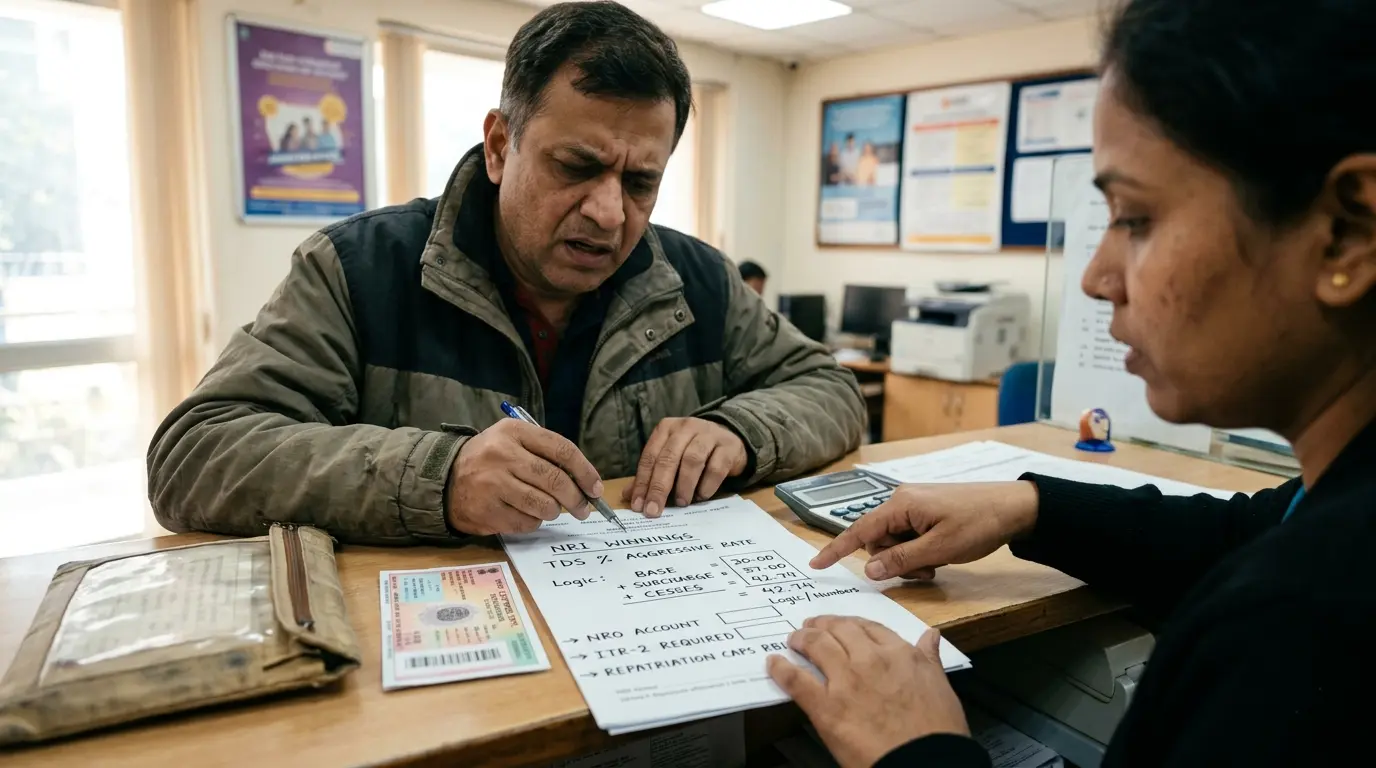
- Section 195 Aggression: Furthermore, deductors process expat windfalls under strict non-resident withholding rules, pushing the effective tax rate as high as 42.74%.
- Zero DTAA Shielding: Consequently, Double Taxation Avoidance Agreements completely exclude windfall, lottery, and gambling profits from relief.
- Filing Mandate: In addition, NRIs must file a specialized ITR-2 return using their temporary or non-resident status to manually reclaim any excess TDS.
The Non-Resident Framework for NRI Lottery Winnings Tax in India
The Indian tax framework evaluates cross-border windfall capital based on your physical presence during the financial year. Primarily, the state does not grant non-residents the basic tax exemptions or slab benefits available to local citizens.
The Intersection of Section 393 and Section 195
Under the updated Income-tax Act, 2025, all domestic lottery payouts are governed by Section 393. However, when the winner is a non-resident, the transaction must also pass through the compliance filters of Section 195.
Consequently, this intersection alters how the payout agent processes your money. Instead of applying a simple flat rate, the clearing entity must calculate withholding taxes based on the maximum potential tax rate for foreign entities. For a closer look at how these fundamental baseline rates are structured, check out our guide on Section 194B and Section 393 Layouts.
Tax Rates on NRI Lottery Winnings Tax in India
The primary compliance hazard for expats lies in the automated application of peak surcharges. Payers are legally required to protect themselves from penalties, which often leads them to over-withhold taxes on non-resident accounts.
Surcharge and Cess Escalations for Non-Residents
While a resident payer enjoys a flat 4% health and education cess, an NRI payout faces a multi-tiered surcharge roadmap. Depending on the total prize value, the system applies surcharges ranging from 10% to 37% directly at the source.
| Prize Valuation Threshold | Base Tax Rate | Applied Surcharge Rate | Final Effective TDS Rate |
| Up to ₹50 Lakhs | 30% | 0% | 31.20% |
| ₹50 Lakhs to ₹1 Crore | 30% | 10% | 34.32% |
| ₹1 Crore to ₹2 Crores | 30% | 15% | 35.88% |
| Above ₹2 Crores | 30% | 25% / 37% | Up to 42.74% |
As a result, an expat winning a major prize can lose nearly half of their total windfall before the cash ever hits an NRO or NRE account. To calculate exactly how these aggressive tiers will impact your specific prize amount, run your numbers through our comprehensive Lottery Tax Calculator India tool.
DTAA Exclusions and the Myth of Double Taxation Relief
Expat communities frequently share misleading advice regarding Double Taxation Avoidance Agreements (DTAA). Many believe these treaties will automatically shield them from being taxed twice on the same income.
Why Tax Treaties Fail to Protect NRI Lottery Winners
Primarily, global tax treaties are designed to protect active business profits and professional salaries rather than casual windfalls. Almost every DTAA signed by India completely excludes lotteries, card games, betting pools, and race rewards from mutual tax relief benefits.
Thus, you will likely pay full taxes in India at the source, and you may still face additional disclosure liabilities in your current country of residence. This strict rule mirrors the global standard applied to international players, which you can explore further in our analysis of Tax on Foreign Lottery Winnings in India.
Compliance and Refund Protocols for Expats
Recovering over-withheld funds from the tax department requires following a precise, sequential filing process. If you submit incorrect documentation, your application will be automatically rejected by the centralized portal.
How to Correctly File ITR-2 as an NRI
To legally reclaim excess surcharge allocations, you must file your annual return using Form ITR-2. Specifically, do not attempt to hide your expat status to bypass non-resident verification checks.
Step 1: Match Form 16A TDS logs with your Form 26AS ledger entries.
Step 2: Declare the gross prize value inside Schedule OS (Income from Other Sources).
Step 3: Compute the exact surcharge relief under foreign status verification scripts.
Furthermore, ensure your NRO bank account is fully pre-validated on the electronic filing platform. The system cannot process international wire transfers or non-resident refunds if your account validation status is pending. For formal verification of non-resident filing mandates, always review the updated structural guidelines on the Official Income Tax Department Portal.
Frequently Asked Questions
Is an NRI lottery win taxable in India?
Yes, any lottery win originating in India is fully taxable for NRIs. The income tax framework states that all windfall income earned within Indian borders is subject to immediate taxation, regardless of the winner’s current country of residence.
Why do NRIs pay higher TDS on lottery winnings?
NRIs face higher TDS rates because Section 195 requires payers to deduct both the base tax and the maximum applicable surcharges at the source. This requirement can push the final withholding rate as high as 42.74% for large prize amounts.
Can an NRI use DTAA to avoid Indian lottery tax?
No, NRIs cannot use DTAA provisions to avoid windfall taxes. Most international tax treaties signed by India explicitly exclude casual income, gambling winnings, and lottery prizes from double-taxation protection or relief benefits.
Which ITR form should an NRI use for lottery income?
An NRI must use Form ITR-2 to report lottery income and claim any eligible tax refunds. You must declare the total gross winnings inside Schedule OS while ensuring your non-resident bank details are fully validated for processing.
Can lottery winnings be deposited into an NRE account?
No, organizers cannot deposit local lottery winnings directly into an NRE account. The funds must first clear through an NRO account, where they remain subject to standard repatriation caps and RBI compliance checks.
Conclusion & Next Steps
In summary, managing the nri lottery winnings tax in india requires careful navigation of both Section 393 and Section 195 compliance rules. While the base tax rate remains fixed at 30%, hidden surcharge escalations can easily drain your cross-border windfall if left unmanaged.
Therefore, secure your official Form 16A certificates from the distributing agent as soon as possible. Additionally, make sure your cross-border accounting team reviews your Form 26AS ledger entries carefully before submitting an ITR-2 refund request.