
Disclaimer: This guide provides informational content only and does not serve as legal advice. Always confirm current laws with the relevant government authority or a qualified legal professional.
If you have ever wondered why purchasing a lottery ticket is perfectly legal in Kerala but a punishable crime just across the border in Karnataka, the answer lies in one central law. Everything comes down to the lotteries regulation act 1998.
Before lawmakers enacted this central legislation, the Indian lottery market suffered from a lack of regulation, leading to widespread financial distress and the rapid growth of private, black-market draws. Consequently, the 1998 Act brought order to the system by creating a strict framework that empowered individual state governments. To understand exactly how this law affects where you live and whether you can safely play, review our master map of the Lottery Legal States in India.
In this guide, we break down exactly what the lotteries act explained means for you, how it regulates ticket sales, and why it forms the legal backbone of all state draws in the country.
Key Takeaways Under the Lotteries Regulation Act 1998
- State Power: First, the Act gives individual states the absolute authority to permit or ban lotteries within their borders.
- Government Monopoly: Second, private lotteries act as illegal enterprises; the law mandates that only state governments can organize and run draws.
- Cross-Border Control: Third, states possess the right to prohibit the sale of other states’ lottery tickets within their jurisdiction.
- Strict Operations: Finally, the subsequent lotteries regulation rules 2010 enforce rigid standards on how authorities print tickets, sell them, and distribute prizes to prevent fraud.
How the Central Lottery Law India Empowers States
While local officials manage lotteries, the central lottery law india provides the structural rulebook. Under the Indian Constitution, lotteries function as a “State subject,” but the central government stepped in with the 1998 Act to ensure national guidelines prevented private exploitation.
Primarily, the core function of the Act focuses on delegation. It does not explicitly force any state to run a lottery, nor does it force a state to ban them. Instead, it grants state lottery authorisation powers directly to the state legislative assemblies.
Section 4 Lotteries Act: Strict Requirements
Crucially, if a state wants to legally run a lottery, it must strictly adhere to the section 4 lotteries act. Specifically, this section outlines the mandatory conditions a state government must meet. If a state fails these conditions, its lottery operates illegally.
- State Imprint: First, the state government must print the tickets and include the official state logo to ensure authenticity.
- Treasury Direct: Second, officials must deposit all proceeds from ticket sales directly into the public state treasury.
- Direct Draws: Third, the state government itself must conduct the draws or supervise them directly.
- Frequency Limits: Finally, Section 4 limits the number of bumper draws a state can hold per year (traditionally capped at six) to prevent predatory daily gambling practices.
Because of these strict requirements, you will find that while some jurisdictions theoretically have authorisation, they do not currently run active draws. For example, you can see how this nuance plays out by reading our breakdown on whether is lottery legal in Maharashtra.
Understanding the Lotteries Regulation Rules 2010
Twelve years after passing the initial Act, the central government recognized the need for tighter operational security and introduced the lotteries regulation rules 2010.
While the 1998 Act decided who could run a lottery, the 2010 Rules decided how operators must run them. Lawmakers designed these rules to protect consumers by enforcing transparency. Specifically, they mandate that:
- Ticket Security: Authorities must print tickets in high-security, government-approved presses.
- Clear Payouts: States must pre-announce their prize structures transparently.
- Agent Restrictions: Distributors and selling agents cannot manipulate prize money or conduct their own parallel draws.
Taxation Under the Lotteries Regulation Act 1998
Importantly, the lotteries regulation act 1998 governs the legality of the draw, but it works in tandem with national tax laws. Whenever a state runs a legal draw, officials must legally deduct tax at the source (TDS) before handing over the prize money.
Currently, the Income Tax Department taxes winnings at a flat 30% plus a 4% cess (totaling 31.2%) under Section 194B (which transitions to Section 393(3) effective April 1, 2026). If you want to understand how the 1998 Act interacts with tax liabilities, we highly recommend reading our Complete Guide to Lottery in India.
Frequently Asked Questions (FAQ)
Defining the Act and State Powers
1. What is the Lotteries (Regulation) Act 1998? Essentially, the lotteries regulation act 1998 serves as the central legislation providing the legal framework for lotteries in India. It delegates the absolute power to permit, regulate, or ban lotteries to individual state governments, ending unregulated private lotteries.
2. What does the Act allow state governments to do? Specifically, it allows states to run their own official government lotteries, appoint licensed distributors, or enact total legislative bans on all lotteries within their borders to protect local public welfare.
3. What makes a lottery legal under the Act? Legally, a lottery remains valid only if the state government organizes, conducts, and controls it. Furthermore, tickets must bear the official state logo, and officials must deposit all generated revenues directly into the public treasury.
Interstate Rules and Digital Laws
4. Can a state sell its lottery in another state? Yes, but only if the receiving state also legally permits lotteries and explicitly allows cross-border sales. Crucially, under Section 5 of the Act, a state possesses the legal right to ban tickets from any other state.
5. Does the Act cover online lotteries? Yes, the Act applies to all forms of lotteries. Consequently, states that authorize lotteries must explicitly license online versions. Currently, only a few states permit online draws, while most legal states restrict sales strictly to physical paper tickets.
6. Has the 2025 Online Gaming Act changed it? No. The 2025 Online Gaming Act regulates digital skill games, betting, and offshore platforms, but state-run lotteries remain governed primarily by the 1998 Act. Therefore, new digital policies simply help states enforce their existing lottery bans online.
Enforcement and Legal Definitions
7. What are the Lotteries (Regulation) Rules 2010? Basically, these represent detailed operational rules issued by the central government. Specifically, they strictly govern ticket printing at secure presses, transparent draw procedures, prize distributions, and the minimum frequency of draws.
8. Who enforces the Act? Primarily, state police, state commercial tax boards, and state lottery departments handle enforcement. However, the central government can intervene if a state directly violates the core operational provisions.
9. Can the central government ban a state’s lottery? Generally, the central government does not outright ban a state’s lottery. However, they can intervene if a state operates draws in direct violation of Section 4 conditions—such as illegally outsourcing complete control to a private company.
10. How does the Act define a lottery? Legally, the Act defines a lottery as a scheme for the distribution of prizes by lot or chance to persons participating by purchasing tickets. Importantly, this definition separates lotteries from games of skill.
What To Do Next
In conclusion, understanding your rights under the lotteries regulation act 1998 remains the best way to protect yourself from fraud. Because the law strictly bans private operators, you should never trust a private company claiming to run a nationwide draw.
- Check Your Local Laws: First, ensure your state permits lotteries before attempting to play. Review our Lottery Legal States in India map.
- Look for the State Imprint: Second, if you purchase a ticket, verify it contains the official state government logo and printing press details as mandated by the 2010 Rules.
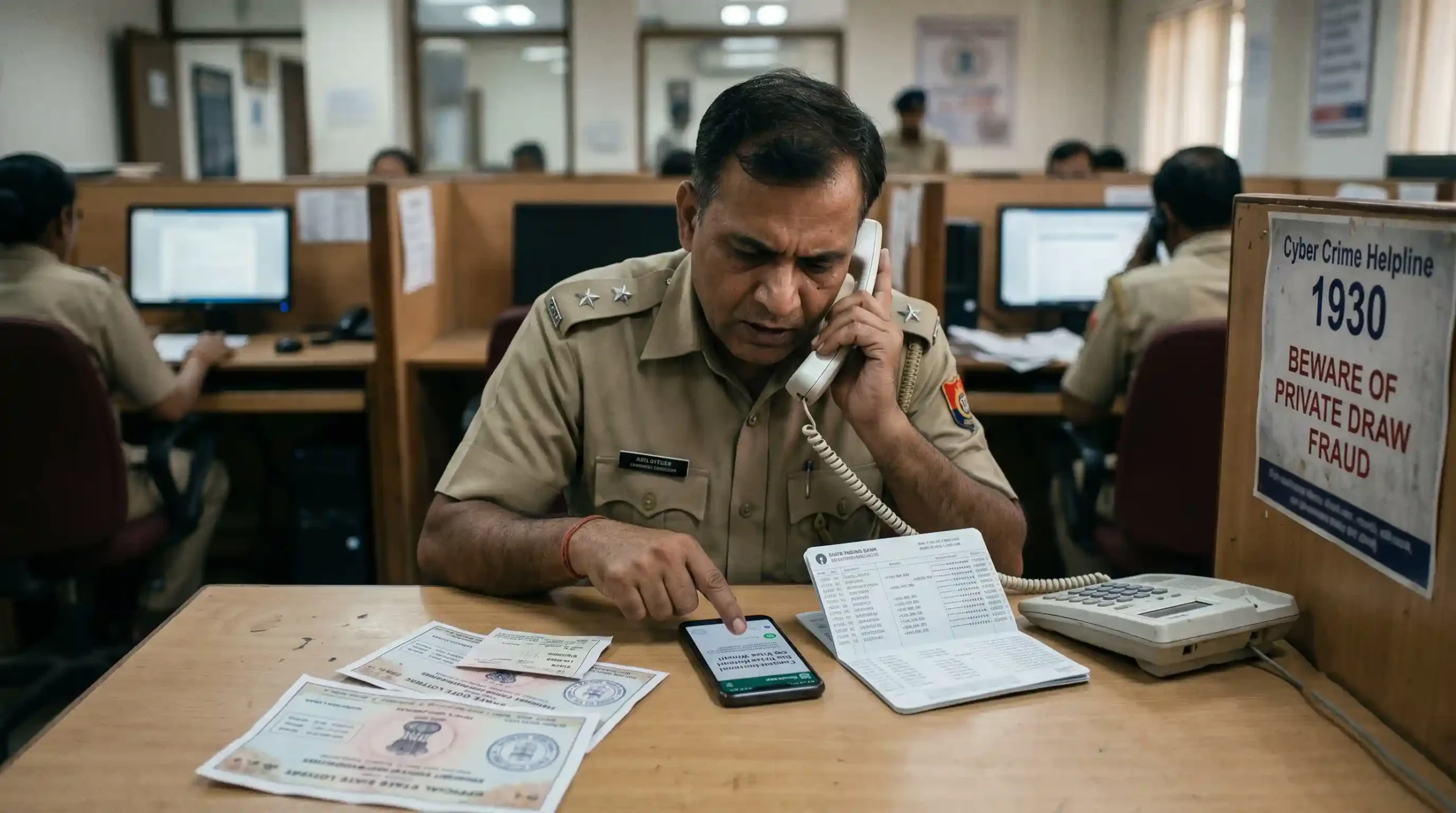
- Report Violations: Finally, if a private entity runs an illegal lottery in your area, report it to the National Cyber Crime Reporting Portal or call the 1930 national helpline.