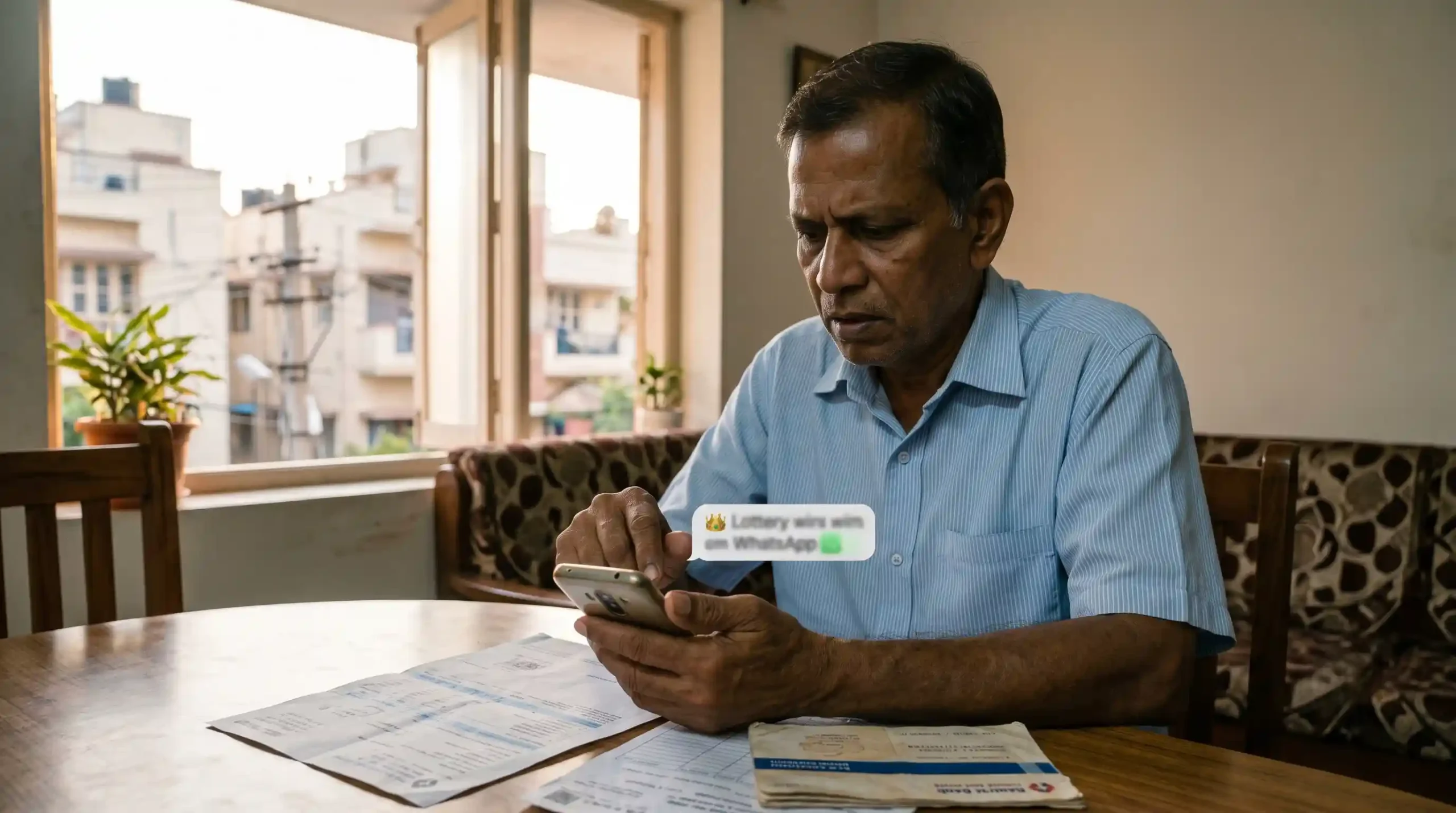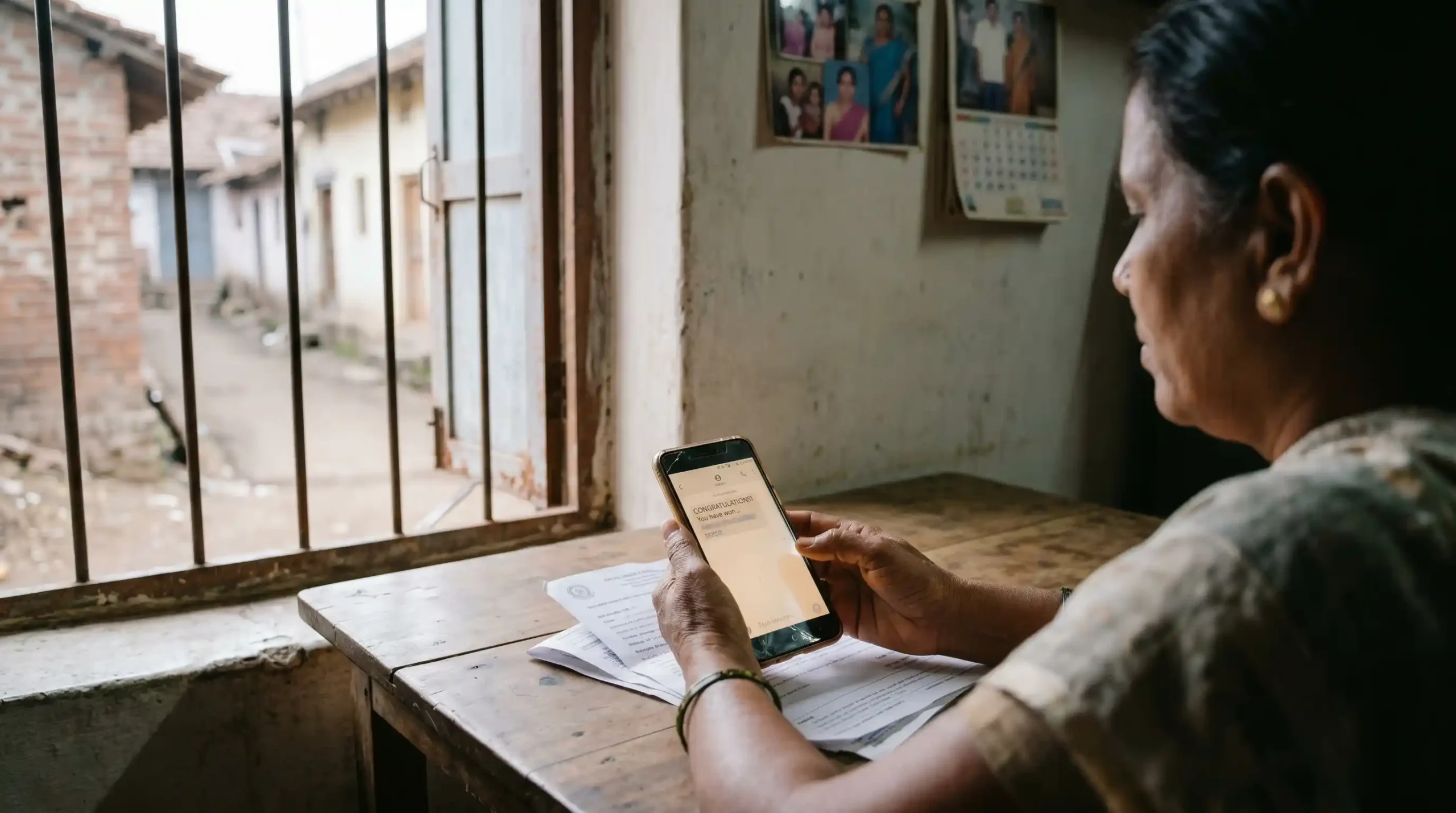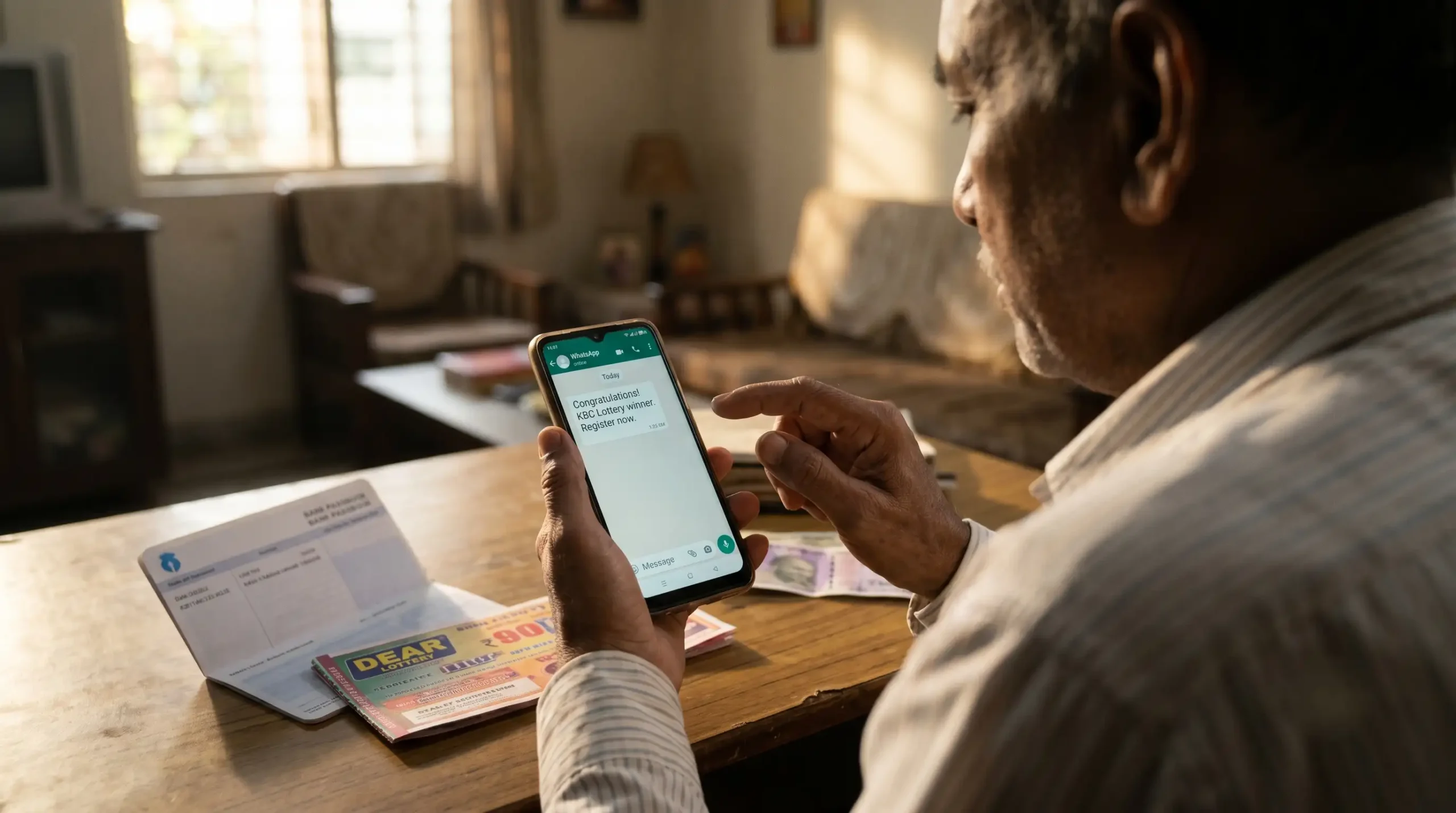
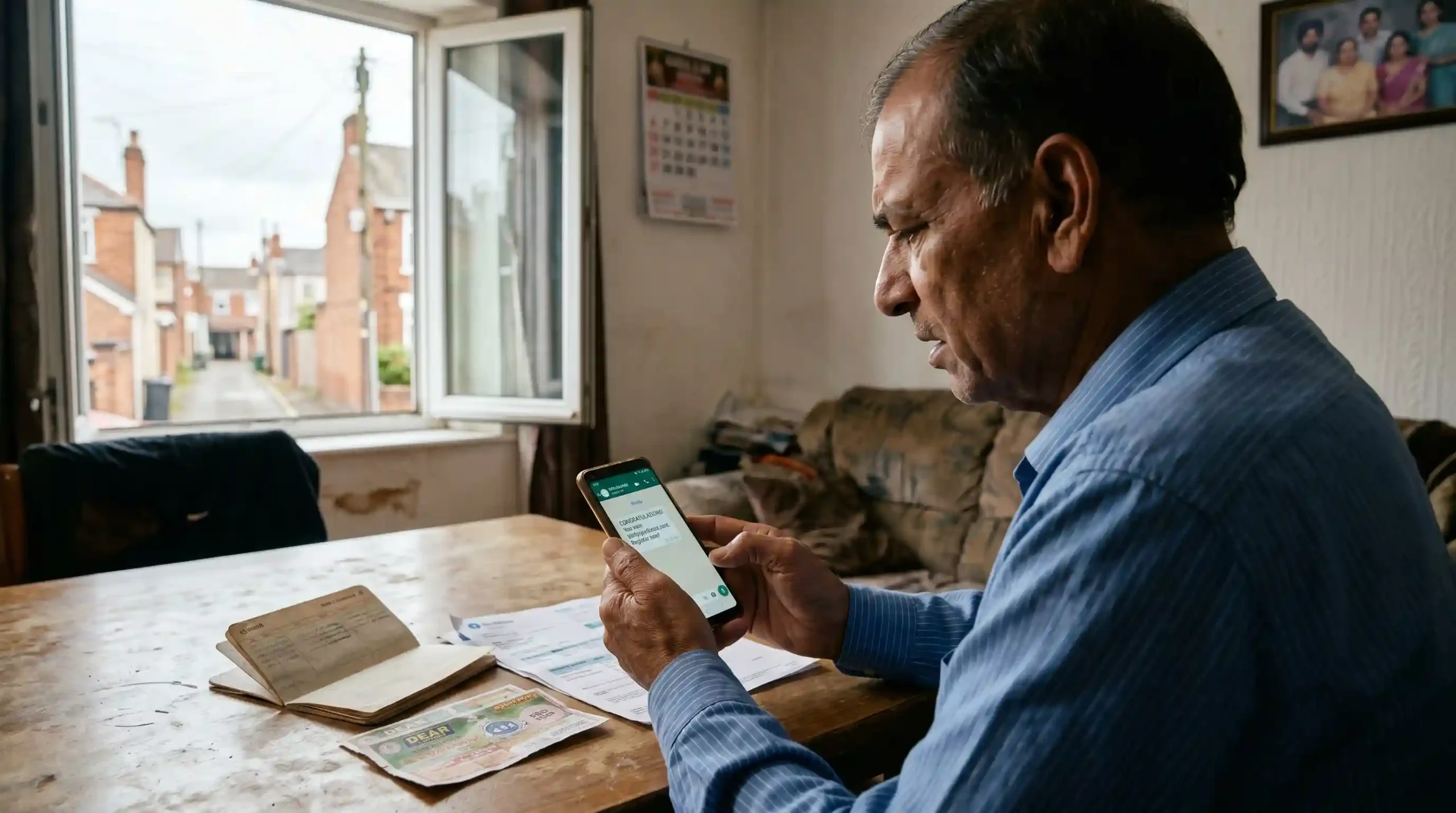
5 Signs a Lottery Winning SMS Is Fake

Already responded to a suspicious text message? Do this now:

  • Do not send money or share OTPs. If they ask for an advance fee to give you your prize, it is a scam.
  • Do not click any links. If you did, do not type any information on the page that opens.
  • Report financial loss instantly. If you have already lost money, call the National Cyber Crime Helpline at 1930 immediately, and file a report atcybercrime.gov.in.
  • Contact your bank. Tell them to freeze your account to stop any more money from being taken.

It usually starts with a sudden, unexpected text message. Your phone buzzes, and the screen shows a message claiming you have won a massive cash prize in a lucky draw. If you are reading this right now, chances are you are looking at a fake lottery winning sms and wondering if it is real.

Stop, take a breath, and do not tap anything.

Our complete guide to the playbook of lottery scams in India shows that a fake lottery winning sms is usually the very first trap scammers use. They use a massive prize as bait to steal your money or your bank details. Real lotteries simply do not work this way. Here is exactly how to spot a scam text before it costs you your savings.

Key Takeaways

  • The most vital rule: Never click links, call the number, or reply to an unexpected text claiming you won a lottery.
  • No upfront fees: Real lotteries take taxes out before paying you; they never ask winners to send money first.
  • Silence is safety: Replying “STOP” to a spam text only proves to scammers that your phone number is active.
  • Act fast if tricked: If you shared your details, call 1930 immediately to stop the fraud.

How to Spot a Fake Lottery Winning SMS

Scammers send out thousands of text messages every day, hoping just a few people will reply. While the exact words change, their tricks are always the same. Look for these five clear red flags in any message claiming you won a prize.

1. You Never Bought a Ticket for That Draw

The golden rule of lotteries is simple: you cannot win a game you did not play. Scammers often use the names of major brands, phone networks, or popular TV shows to make their texts look real. If you get a text about a draw you did not buy a ticket for, it is a fake.

2. The Text Demands an Advance Fee or ‘Tax’

A classic sign of an advance fee lottery scam is the demand for a “processing fee,” “registration charge,” or “GST clearance” before you can get your prize.

Real Lottery Taxes: Under Indian law, real lottery wins have a flat 30% tax plus a 4% Health and Education Cess, bringing the total cut to 31.2%. This Tax Deducted at Source (TDS) is taken out before the prize is paid to you, according to theIncome Tax Department of India. A real lottery will never ask you to pay taxes out of your own pocket using UPI or a bank transfer.

3. It Includes a Suspicious Link

A real state lottery will tell you to check the official government gazette or verified department website. A fake lottery winning sms will almost always include a shortened or strange-looking link. This is known as smishing. Clicking this link may put harmful viruses on your phone or take you to a fake website built to steal your passwords.

4. The Sender Wants You to Switch to WhatsApp

Official government lotteries do not handle real business using private WhatsApp numbers. If the text tells you to contact a “Lottery Manager” on a standard 10-digit mobile number, you are talking to a scammer’s call centre. This trick is very common with the fake KBC lottery WhatsApp message fraud.

Warning: Be highly suspicious of messages sent from normal 10-digit mobile numbers. Real business texts use official 6-character sender IDs (like AD-LOTTRY) required by theTelecom Regulatory Authority of India.

5. It Threatens You With a Deadline

Scammers want you to panic. They will say that your prize will be cancelled or given to someone else if you do not reply within 24 hours. This fake rush is meant to stop you from thinking clearly or checking their claims.

What to Do If You Receive a Scam SMS

If you spot these signs, your best defense is doing nothing at all.

  • Do not reply: Not even to insult the scammer or text “STOP”. Replying proves your number belongs to a real person.
  • Block the sender: Use your phone’s settings to block the contact.
  • Report the message: You can report spam texts through your phone provider or the DND app. For your own safety, practice Responsible Lottery Play by ignoring unexpected offers.

If the scam goes further and you realize you have been tricked into sending money or sharing an OTP, drop everything. Follow the exact steps to report the scam in India to give yourself the best chance of getting your money back.

Frequently Asked Questions

How do I know if a lottery winning SMS is fake?

An SMS is fake if you didn’t enter the draw, if the message has strange links, if it comes from a standard 10-digit mobile number instead of a business ID, or if it demands an upfront fee to claim the money.

Do real lotteries notify winners by SMS?

No. Real, government-backed state lotteries in India print winning numbers in the official state gazette and on their official websites. They do not text winners directly, because physical tickets are not linked to your phone number.

What are common red flags in a scam lottery text?

Red flags include terrible spelling, promises of massive wealth in foreign money, fake deadlines (like “claim within 24 hours”), links to unknown websites, and instructions to keep your win a secret.

Why does the SMS include a link or phone number?

The link is meant to put harmful software on your phone or send you to a fake login page to steal your bank details. The phone number connects you to a professional thief trained to trick you into sending money.

Is it safe to reply STOP or call the number?

No. Replying “STOP,” insulting the scammer, or calling the number proves that your phone number is active. This will instantly cause you to get even more spam and scam texts from other numbers.

What happens if I click the link in the SMS?

Clicking the link may silently download viruses or tracking software onto your phone. It might also send you to a very realistic fake website that asks for your bank details, Aadhaar number, or UPI PIN to “verify” you.

How do scammers get my mobile number?

Scammers buy lists of active phone numbers from data thieves on the internet, steal them from hacked apps, or use software to guess and text thousands of random phone numbers all at once.

Should I report the sender to my telecom or 1930?

If you have not lost any money, report the number as spam to your phone provider (for example, by forwarding the text to 1909). If you have lost money or shared your bank details, call the cybercrime helpline at 1930 immediately.

Can I block and trace a scam SMS sender?

You should always block the sender using your smartphone’s settings. Tracing the sender is extremely hard for everyday people, as scammers use fake numbers and untraceable internet connections. Leave the tracing to the police.

What if I already shared an OTP or details?

Act right away. Call your bank’s emergency number to freeze your accounts and block your cards or UPI access. Then, call 1930 to report the fraud and file a formal police complaint at cybercrime.gov.in.
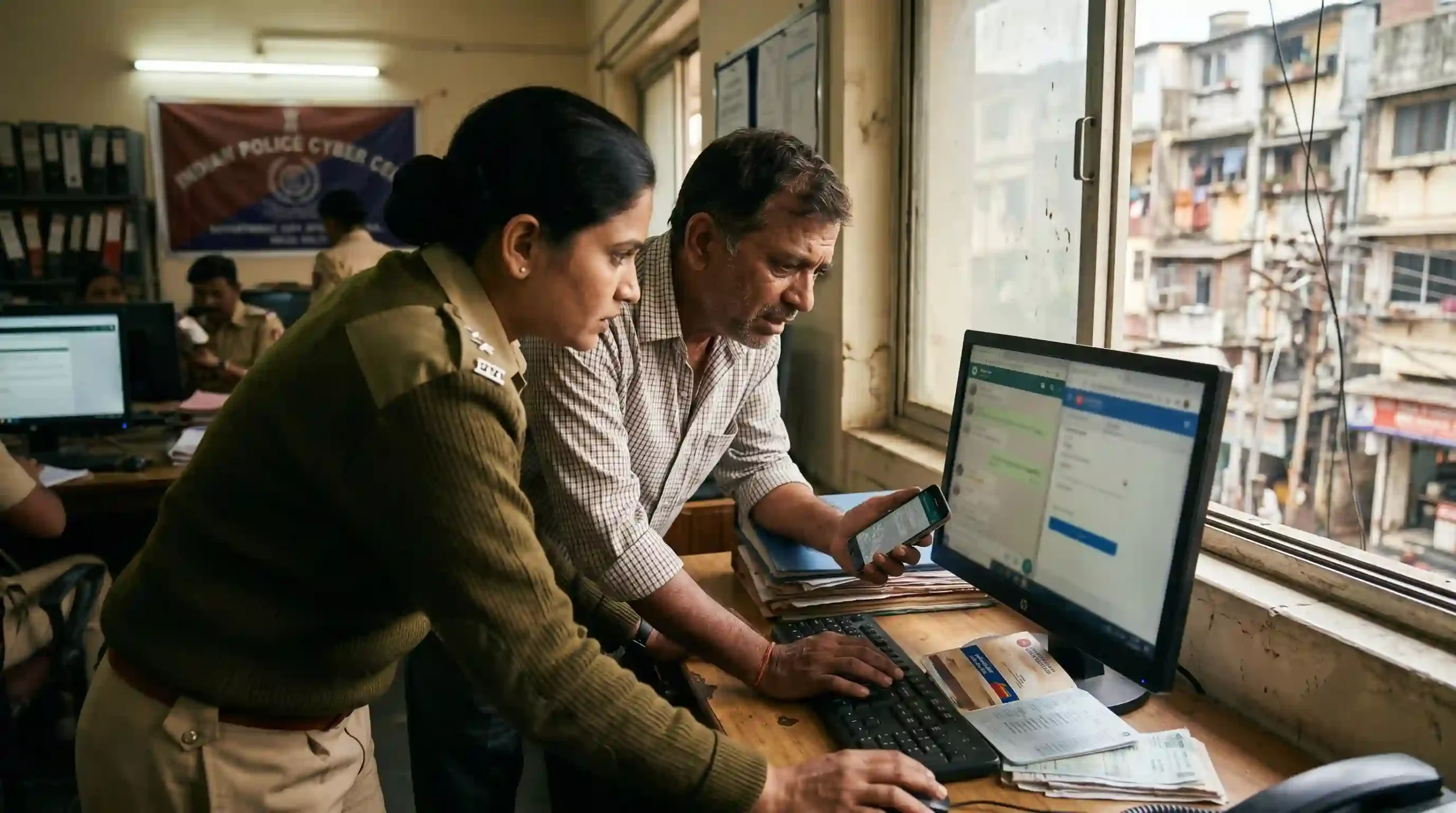

Scammed by a Lottery? The First 24 Hours Matter

Already been targeted or scammed? Do this now.

Did you click a link in a deepfake celebrity lottery endorsement and share your bank details? Stop all communication immediately.

  1. First, call 1930 (the National Cyber Crime Helpline) right now. Specifically, this action freezes your transaction.
  2. Second, file a formal cyber fraud complaint at theNational Cyber Crime Reporting Portal.
  3. Finally, contact your bank immediately. Furthermore, instruct them to block your debit cards and your UPI access.

You scroll through your social media feed, and suddenly, a familiar face appears. For instance, you see a trusted actor or a famous news anchor personally promising you a guaranteed spot in a massive prize draw. However, do not trust it. In reality, this video is a deepfake celebrity lottery endorsement, and it is a highly deceptive scam designed to steal your money. Indeed, this method ranks as one of the most dangerous lottery scams in India today.

Therefore, you must understand exactly how these scams operate. Fraudsters weaponise artificial intelligence (AI) to bypass your natural caution. Consequently, scammers clone famous faces to trick you into false trust. As a result, users click malicious links or pay fake entry fees.

In this guide, we explain these fabricated videos in detail. First, you will learn the distinct digital tells. Second, you will discover the exact steps to take to protect your finances.

Key Takeaways

  • Never Trust the Face Value: Most notably, scammers use AI to generate videos that promise guaranteed lottery wins.
  • Look for the “Tells”: Unnatural blinking, robotic vocal tones, and blurry jawlines clearly expose a deepfake.
  • Celebrities Are Victims Too: Furthermore, fraudsters steal public footage. Thus, the celebrity does not endorse the lottery.
  • Never Click the Link: Specifically, fraudsters use “Sign Up Now” buttons to steal your KYC details and banking information.
  • Report Immediately: Flag the video on the social platform. Additionally, report any financial loss directly to the cyber helpline.

What is a Deepfake Celebrity Lottery Endorsement?

Primarily, fraudsters rely on advanced software to manipulate existing video and audio. First, they scrape hours of public interviews from a famous person. Next, they feed this data into an AI tool. Consequently, the AI learns the person’s facial expressions, voice pitch, and cadence.

How AI Generates These Fake Videos

Once the AI finishes training, the scammer types a specific script. For example, they might type, “Click the link below to enter my exclusive ₹50 Lakh lottery draw!” Subsequently, the software generates a highly realistic video. Thus, the AI makes the cloned celebrity say those exact words.

The Celebrity is Not Involved: You must understand that the public figure did not approve this message. In fact, criminals stole their digital identity to sell a fake prize draw. Therefore, the video is AI, not a real advertisement.

How to Spot a Fake Video Endorsement

Deepfake technology improves rapidly. However, it rarely looks perfect. Fraudsters prioritize speed over quality. Consequently, their videos often contain distinct visual and audio errors.

Visual and Audio Red Flags

When you see a suspicious ad on your feed, carefully look for these specific warning signs:

  • Lip-Sync Failures: The mouth movements do not perfectly align with the spoken words. In particular, pay close attention to sharp consonant sounds like P, B, or M.
  • Unnatural Eye Movements: Similarly, deepfakes struggle with natural blinking. Therefore, the eyes might stare blankly or look in the wrong direction.
  • Audio Glitches: Listen closely to the voice. It often sounds slightly robotic or flat. In addition, it completely lacks natural emotional inflection.
  • Blurry Edges: Look closely at the jawline and hair. Often, you will see a slight blurring where the AI mask meets the original head.

The Trap Inside a Deepfake Celebrity Lottery Endorsement

These fake videos share one ultimate goal. Ultimately, they desperately want you to click the link provided in the video caption. Once you click, you immediately step into a highly structured trap.

Step-by-Step Data Theft

First, the link directs you to a phishing portal. This website perfectly mimics an official state lottery page. Second, the site prompts you to register. Specifically, they ask for your name, phone number, PAN card, and bank details.

Third, the scammers trigger the “processing fee” trap. They tell you that you won. However, they demand a small, refundable fee via UPI to release the funds. Finally, scammers might use your number to send a fake lottery SMS. Alternatively, they might add you to a Telegram lottery group scam to extract even more money.

The Real Role of Brand Ambassadors

Legal state lotteries sometimes hire public figures for marketing. Nevertheless, legitimate brand ambassadors always operate under strict boundaries.

The Golden Rule of Endorsements: Legitimate brand ambassadors appear in verified campaigns to promote the brand. However, they never run direct prize draws. Furthermore, they never message you privately. Finally, they absolutely never ask you to send money to unlock a ticket.

For absolute peace of mind, always practice safety first. Therefore, read our Complete Guide to Lottery in India to understand exactly how legal draws actually function.

How to Report a Deepfake Celebrity Lottery Endorsement

If you spot a deepfake celebrity lottery endorsement, taking swift action protects both you and your community.

Immediate Actions to Take

First, do not engage. Never comment on the video, because social media algorithms view comments as engagement. Consequently, the platform simply shows the video to more people.

Second, report the video in-app. Specifically, use the reporting tool on Facebook, Instagram, or YouTube. Then, select “Scam” or “Misleading AI content” to instantly alert the moderators.

Finally, handle financial fraud aggressively. If you clicked the link and transferred money, you must immediately report a lottery scam in India.

Where to Report: Call the National Cyber Crime Reporting Helpline at 1930. Alternatively, file a detailed report at theofficial government cyber portal. —

Frequently Asked Questions

Understanding AI Lottery Scams

1. Are celebrity lottery endorsement videos real?

No. Videos showing a celebrity personally promising a guaranteed lottery win are scams. Criminals use artificial intelligence to steal the celebrity’s face. Consequently, they trick you into clicking malicious links.

2. What is a deepfake lottery endorsement?

It is a fraudulent video created using advanced software. First, scammers clone a famous person’s face and voice. As a result, they make it appear as though the celebrity endorses a fake prize draw.

3. Which celebrities do scammers fake in lottery ads?

Scammers typically target highly trusted figures. For instance, they clone veteran actors, popular news anchors, and top cricketers. Therefore, the familiar faces immediately generate false trust among the public.

Spotting the Digital Tells

4. How can I tell a video is AI-generated?

Look for specific visual errors. Often, you will notice unnatural blinking and lips that do not match the spoken words. Furthermore, listen for flat audio and look for blurry edges around the jawline.

5. Do lottery ‘brand ambassadors’ run prize draws?

No. Legal lotteries hire celebrities for general brand marketing. However, these ambassadors never run personal prize draws. Moreover, they also never ask the public for upfront entry fees.

6. Why do these ads appear in my social feed?

Scammers buy ad space on social media platforms just like legitimate businesses. Consequently, they use broad targeting to reach millions of users quickly before safety systems catch the fake video.

Protecting Your Data and Money

7. What do the linked sites try to collect?

The links lead directly to dangerous phishing websites. Fraudsters design these pages specifically to steal your personal information. Consequently, they want your mobile number, PAN details, banking information, and UPI PINs.

8. How do I report a deepfake ad or page?

First, do not click the link. Second, use the three dots on the social media post. Finally, report the ad directly to the platform as “Fraud” or “Scam”.

9. Is sharing a deepfake endorsement illegal?

Knowingly creating and distributing deepfakes to defraud people constitutes a cybercrime in India. While accidentally sharing one is not a crime, you must delete it immediately to protect your friends.

10. What if I clicked the link or paid?

If you paid any money, call the cyber helpline at 1930 immediately. Consequently, this step freezes your account. Next, file a formal complaint at cybercrime.gov.in and alert your bank.

That Celebrity Lottery Video Is a Deepfake

Already been targeted or scammed? Do this now.

Did you click a link in a deepfake celebrity lottery endorsement and share your bank details? Stop all communication immediately.

  1. First, call 1930 (the National Cyber Crime Helpline) right now. Specifically, this action freezes your transaction.
  2. Second, file a formal cyber fraud complaint at theNational Cyber Crime Reporting Portal.
  3. Finally, contact your bank immediately. Furthermore, instruct them to block your debit cards and your UPI access.

You scroll through your social media feed, and suddenly, a familiar face appears. For instance, you see a trusted actor or a famous news anchor personally promising you a guaranteed spot in a massive prize draw. However, do not trust it. In reality, this video is a deepfake celebrity lottery endorsement, and it is a highly deceptive scam designed to steal your money. Indeed, this method ranks as one of the most dangerous lottery scams in India today.

Therefore, you must understand exactly how these scams operate. Fraudsters weaponise artificial intelligence (AI) to bypass your natural caution. Consequently, scammers clone famous faces to trick you into false trust. As a result, users click malicious links or pay fake entry fees.

In this guide, we explain these fabricated videos in detail. First, you will learn the distinct digital tells. Second, you will discover the exact steps to take to protect your finances.

Key Takeaways

  • Never Trust the Face Value: Most notably, scammers use AI to generate videos that promise guaranteed lottery wins.
  • Look for the “Tells”: Unnatural blinking, robotic vocal tones, and blurry jawlines clearly expose a deepfake.
  • Celebrities Are Victims Too: Furthermore, fraudsters steal public footage. Thus, the celebrity does not endorse the lottery.
  • Never Click the Link: Specifically, fraudsters use “Sign Up Now” buttons to steal your KYC details and banking information.
  • Report Immediately: Flag the video on the social platform. Additionally, report any financial loss directly to the cyber helpline.

What is a Deepfake Celebrity Lottery Endorsement?

Primarily, fraudsters rely on advanced software to manipulate existing video and audio. First, they scrape hours of public interviews from a famous person. Next, they feed this data into an AI tool. Consequently, the AI learns the person’s facial expressions, voice pitch, and cadence.

How AI Generates These Fake Videos

Once the AI finishes training, the scammer types a specific script. For example, they might type, “Click the link below to enter my exclusive ₹50 Lakh lottery draw!” Subsequently, the software generates a highly realistic video. Thus, the AI makes the cloned celebrity say those exact words.

The Celebrity is Not Involved: You must understand that the public figure did not approve this message. In fact, criminals stole their digital identity to sell a fake prize draw. Therefore, the video is AI, not a real advertisement.

How to Spot a Fake Video Endorsement

Deepfake technology improves rapidly. However, it rarely looks perfect. Fraudsters prioritize speed over quality. Consequently, their videos often contain distinct visual and audio errors.

Visual and Audio Red Flags

When you see a suspicious ad on your feed, carefully look for these specific warning signs:

  • Lip-Sync Failures: The mouth movements do not perfectly align with the spoken words. In particular, pay close attention to sharp consonant sounds like P, B, or M.
  • Unnatural Eye Movements: Similarly, deepfakes struggle with natural blinking. Therefore, the eyes might stare blankly or look in the wrong direction.
  • Audio Glitches: Listen closely to the voice. It often sounds slightly robotic or flat. In addition, it completely lacks natural emotional inflection.
  • Blurry Edges: Look closely at the jawline and hair. Often, you will see a slight blurring where the AI mask meets the original head.

The Trap Inside a Deepfake Celebrity Lottery Endorsement

These fake videos share one ultimate goal. Ultimately, they desperately want you to click the link provided in the video caption. Once you click, you immediately step into a highly structured trap.

Step-by-Step Data Theft

First, the link directs you to a phishing portal. This website perfectly mimics an official state lottery page. Second, the site prompts you to register. Specifically, they ask for your name, phone number, PAN card, and bank details.

Third, the scammers trigger the “processing fee” trap. They tell you that you won. However, they demand a small, refundable fee via UPI to release the funds. Finally, scammers might use your number to send a fake lottery SMS. Alternatively, they might add you to a Telegram lottery group scam to extract even more money.

The Real Role of Brand Ambassadors

Legal state lotteries sometimes hire public figures for marketing. Nevertheless, legitimate brand ambassadors always operate under strict boundaries.

The Golden Rule of Endorsements: Legitimate brand ambassadors appear in verified campaigns to promote the brand. However, they never run direct prize draws. Furthermore, they never message you privately. Finally, they absolutely never ask you to send money to unlock a ticket.

For absolute peace of mind, always practice safety first. Therefore, read our Complete Guide to Lottery in India to understand exactly how legal draws actually function.

How to Report a Deepfake Celebrity Lottery Endorsement

If you spot a deepfake celebrity lottery endorsement, taking swift action protects both you and your community.

Immediate Actions to Take

First, do not engage. Never comment on the video, because social media algorithms view comments as engagement. Consequently, the platform simply shows the video to more people.

Second, report the video in-app. Specifically, use the reporting tool on Facebook, Instagram, or YouTube. Then, select “Scam” or “Misleading AI content” to instantly alert the moderators.

Finally, handle financial fraud aggressively. If you clicked the link and transferred money, you must immediately report a lottery scam in India.

Where to Report: Call the National Cyber Crime Reporting Helpline at 1930. Alternatively, file a detailed report at theofficial government cyber portal. —

Frequently Asked Questions

Understanding AI Lottery Scams

1. Are celebrity lottery endorsement videos real?

No. Videos showing a celebrity personally promising a guaranteed lottery win are scams. Criminals use artificial intelligence to steal the celebrity’s face. Consequently, they trick you into clicking malicious links.

2. What is a deepfake lottery endorsement?

It is a fraudulent video created using advanced software. First, scammers clone a famous person’s face and voice. As a result, they make it appear as though the celebrity endorses a fake prize draw.

3. Which celebrities do scammers fake in lottery ads?

Scammers typically target highly trusted figures. For instance, they clone veteran actors, popular news anchors, and top cricketers. Therefore, the familiar faces immediately generate false trust among the public.

Spotting the Digital Tells

4. How can I tell a video is AI-generated?

Look for specific visual errors. Often, you will notice unnatural blinking and lips that do not match the spoken words. Furthermore, listen for flat audio and look for blurry edges around the jawline.

5. Do lottery ‘brand ambassadors’ run prize draws?

No. Legal lotteries hire celebrities for general brand marketing. However, these ambassadors never run personal prize draws. Moreover, they also never ask the public for upfront entry fees.

6. Why do these ads appear in my social feed?

Scammers buy ad space on social media platforms just like legitimate businesses. Consequently, they use broad targeting to reach millions of users quickly before safety systems catch the fake video.

Protecting Your Data and Money

7. What do the linked sites try to collect?

The links lead directly to dangerous phishing websites. Fraudsters design these pages specifically to steal your personal information. Consequently, they want your mobile number, PAN details, banking information, and UPI PINs.

8. How do I report a deepfake ad or page?

First, do not click the link. Second, use the three dots on the social media post. Finally, report the ad directly to the platform as “Fraud” or “Scam”.

9. Is sharing a deepfake endorsement illegal?

Knowingly creating and distributing deepfakes to defraud people constitutes a cybercrime in India. While accidentally sharing one is not a crime, you must delete it immediately to protect your friends.

10. What if I clicked the link or paid?

If you paid any money, call the cyber helpline at 1930 immediately. Consequently, this step freezes your account. Next, file a formal complaint at cybercrime.gov.in and alert your bank.

Inside the Telegram Lottery Group Scam in India

Targeted by a Telegram group admin? Do this now.

  1. Do not send money. Never pay “VIP access fees,” “taxes,” or “processing charges” to group admins.
  2. Do not share documents. Do not send photos of your Aadhaar card, PAN, or bank passbook in a chat.
  3. Leave and block. Exit the group immediately and block the admin’s account.
  4. Dial 1930. If you already sent funds, call the National Cyber Crime Helpline instantly to freeze the transfer.
  5. Report the channel. File an official complaint at the National Cyber Crime Reporting Portal. If you recently joined an anonymous messaging channel promising guaranteed jackpot numbers, you are likely inside a telegram lottery group scam. Because the platform allows massive, anonymous public channels, it has become a major hunting ground for fraudsters looking for victims. Specifically, a telegram lottery group scam uses intense psychological manipulation to drain your savings.

As a core part of our commitment to Responsible Lottery Play , we are exposing exactly how this digital illusion operates. Furthermore, to understand how this fits into the broader ecosystem of digital fraud, please read our master guide on the playbook used in lottery scams in India .

Key Takeaways

  • The Wins Are Fake: The screenshots of “winners” receiving massive payouts are entirely staged.
  • Admins Want Advance Fees: The ultimate goal of a telegram lottery group scam is to extort upfront “VIP” fees or fake taxes from you.
  • Never Share KYC: Legitimate lotteries do not ask for your PAN or Aadhaar card via anonymous Telegram DMs.
  • Act Quickly: If you spot fake payout proofs, leave the group, block the admins, and report the channel to the Cyber Crime Portal.

How a Telegram Lottery Group Scam Operates

Fraudsters rely heavily on creating a false sense of community and success. Consequently, they build a fake environment where winning seems guaranteed.

Staged ‘Winner’ Posts and Admin Tactics

When you enter a fake lottery channel, you will immediately see a flood of activity. First, the admins post daily “winning numbers.” Next, anonymous accounts post screenshots of their bank accounts, claiming they just received a massive payout. However, this is a carefully orchestrated illusion. The group admins control multiple fake accounts (bots) to post these forged screenshots. Therefore, the “winners” you see are just the scammers talking to themselves.

Faking Proof of Payouts

Scammers easily forge bank SMS alerts and digital payment receipts using basic photo-editing apps. Consequently, a screenshot of a credited bank balance in a Telegram group is never proof of a legitimate lottery payout.

The Shift to Private Chat

Once you express interest in the group, the trap springs. Specifically, an admin will send you a Direct Message (DM). This is the hallmark of a typical telegram lottery group scam. In the private chat, the admin will offer you a “sure-shot” winning number or VIP membership. But, there is a catch. They will demand an upfront payment via UPI to unlock this secret information. Furthermore, they will apply extreme pressure, claiming the draw happens in minutes.

Extorting Fees and KYC Details

If you pay the initial VIP fee, the fraud escalates quickly. The admin will then claim you won the jackpot. However, they will invent new hurdles to prevent you from getting the money.

  • Fake Taxes: They will demand you pay a “processing fee” or “GST” to release the funds.
  • Data Theft: Next, they will ask for your PAN card, Aadhaar card, and bank account numbers, claiming it is required for “official KYC.”
  • The Blackhole: Ultimately, you will never receive a payout. Once you stop paying fees, the admin will simply block you and delete the chat history.

The Legal Reality of Lottery Tax Under Indian law, legitimate state lottery winnings exceeding Rs. 10,000 are subject to a flat 30% tax plus a 4% cess (effectively 31.2%). Crucially, this tax is deducted at the source (TDS) before the prize is paid out. You never pay this tax upfront from your own pocket to an anonymous admin.

Escaping the Trap: How to Leave and Report

If you are currently in one of these groups, you must act quickly to protect yourself. Unlike WhatsApp lottery scams where they text you directly, Telegram groups require you to proactively leave.

First, take screenshots of the admin’s username and the fake payment requests. Next, tap the group name, scroll to the bottom, and select “Leave Channel.” Finally, to report the activity effectively, you must file your evidence with the authorities. If you have already lost money, immediately read our guide detailing the critical victim recovery steps you must take in the first 24 hours.

Frequently Asked Questions

Group Mechanics and Fake Proof

1. Are Telegram lottery groups real or scams?

Almost universally, anonymous Telegram lottery groups promising guaranteed wins or secret numbers are scams. Legitimate, state-backed lotteries operate through authorized physical retailers and official government websites, never through unverified messaging channels.

2. How do staged ‘winner’ posts trick members?

Scammers use multiple fake accounts to post forged bank screenshots and voice notes thanking the admin for “huge payouts.” Consequently, new members see this fake community success and falsely believe the group is legitimate and profitable.

3. Why do admins move you to a private chat?

Admins move you to a private Direct Message (DM) to isolate you from the group. In a private chat, they can aggressively pressure you for money and manipulate you without other members warning you that it is a scam.

4. How do scammers fake proof of payouts?

Fraudsters use simple photo-editing software or fake SMS generator apps to create convincing images of bank deposit alerts or UPI success screens. Therefore, digital screenshots posted by strangers are never reliable proof of real money.

Demands and Financial Risk

5. What fees or details do they eventually ask for?

Initially, they ask for a small “VIP entry fee.” Later, they demand larger payments for “GST,” “customs clearance,” or “bank transfer charges.” Finally, they will ask for your Aadhaar, PAN, and banking details to steal your identity.

6. What if I shared my bank or KYC details there?

Act instantly. Call your bank’s 24/7 fraud department to freeze your accounts and block your cards. Since scammers now have your ID, you must file an official report at cybercrime.gov.in to protect yourself against future identity theft.

7. Can I recover money sent through a Telegram scam?

Recovery is incredibly difficult, but possible if you act within the “golden hour.” You must dial the 1930 National Cyber Crime Helpline immediately after the transfer. This gives authorities a brief window to potentially freeze the scammer’s destination bank account.

Reporting and Context

8. Are these groups linked to the post-ban gambling shift?

Yes. Following strict government crackdowns and advertising bans on illegal offshore betting apps, many criminal syndicates moved their operations to Telegram. Consequently, they re-branded their gambling rings as “lottery prediction” groups to trap victims.

9. How do I leave and report a scam Telegram group?

First, take screenshots of the scammer’s profile and payment demands. Next, open the group settings and tap “Leave Channel.” Use Telegram’s in-app reporting tool, and then submit your screenshots to the official cybercrime portal.

10. How do I report a Telegram channel to authorities?

Because Telegram is an encrypted platform, local police need your digital evidence. Dial 1930 to report financial loss immediately. Then, go to the National Cyber Crime Reporting Portal and upload the channel link, admin usernames, and your chat screenshots.

A Lottery ‘Refund’ on UPI Only Drains Your Account

If you are on the phone with someone claiming your ticket purchase failed and offering your money back, stop and read this carefully: you are likely the target of a upi lottery refund fraud. Specifically, scammers trick victims into approving a payment under the disguise of sending a refund. Because digital payments happen instantly, falling for this trap can drain your bank account in seconds.

As a core part of our commitment to Responsible Lottery Play, we are exposing exactly how this digital trap works. Ultimately, to understand the wider context of how these criminals operate across India, please review our comprehensive guide on the playbook used in lottery scams in India. ### Key Takeaways

  • PIN Means Pay: First and foremost, your UPI PIN is only used to send money or check your balance, never to receive a refund.
  • Beware the ‘Collect Request’: Specifically, scammers use the UPI ‘collect’ feature to initiate a debit from your account.
  • Screen Sharing is Dangerous: Additionally, never install remote apps like AnyDesk if a “lottery official” asks you to.
  • Act Quickly: Most importantly, if you made a payment, report it within the “golden hour” to maximize your chances of recovery.

How UPI Lottery Refund Fraud Works

Fraudsters deeply exploit the speed and convenience of India’s digital payment infrastructure. Specifically, they rely on the fact that many users misunderstand how the Unified Payments Interface functions when receiving money.

Typically, a upi lottery refund fraud begins with a sudden phone call or SMS. First, the scammer poses as a customer service agent from a state lottery or a popular digital payment app. Next, they claim a recent transaction failed or that you are entitled to a special cashback reward. To complete the illusion, they send a notification directly to your Google Pay, PhonePe, or Paytm app.

Why Am I Asked to Approve a ‘Collect Request’?

Unlike a standard bank transfer where you initiate the payment, the system allows a merchant or individual to request money from you. Consequently, this specific feature is hijacked to create a upi collect request scam.

When the scammer triggers this request, your phone displays a notification. However, the scammer will aggressively instruct you to approve the prompt and enter your 4-digit or 6-digit PIN. If you follow their instructions, you are actively authorizing your bank to transfer your funds into the scammer’s account.

The RBI’s Golden Rule for UPI TheReserve Bank of India (RBI)strictly mandates customer awareness regarding UPI PINs. The fundamental rule is: UPI PIN is required ONLY for making a payment, not for receiving money.

Spotting a Fake Refund UPI Fraud Quickly

Fortunately, preventing a fake refund upi fraud is simple once you recognize the psychological tricks the fraudsters use. Always watch for these immediate red flags:

  • The Word “Pay”: Even if the scammer says they are sending money, the primary button on your UPI app will clearly say “Pay” or “Send”.
  • Fabricated Fees: Sometimes, they rebrand the scam as a lottery processing fee upi charge. Consequently, they claim you must pay a small refundable tax to unlock a larger prize.
  • High-Pressure Tactics: Furthermore, the caller will create extreme urgency. For instance, they might claim the refund link will expire in exactly two minutes if you do not act instantly.

In addition to direct collect requests, scammers heavily abuse QR codes. Often, they will send you a QR code via WhatsApp, calling it your “cashback voucher.”

QR Code Danger: Crucially, scanning a QR code is functionally identical to making a payment. Therefore, if you scan a code and your app asks for your UPI PIN, you are about to send money directly to a fraudster.

Avoiding the Screen-Sharing Trap

Should I install any app they recommend? Absolutely never. Frequently, a common escalation of this fraud involves the scammer asking you to download screen-sharing applications like AnyDesk, QuickSupport, or TeamViewer. If you install these apps, the scammer can watch your screen, read your OTPs, and see you type your UPI PIN. As a result, this gives them total control over your bank account.

Stopping a UPI Lottery Refund Fraud Attack

Unfortunately, reversing a UPI transaction is incredibly difficult. Because UPI is a real-time settlement system, the money leaves your account and enters the scammer’s wallet instantaneously. Consequently, a traditional reverse upi payment fraud procedure is rarely as simple as pressing an “undo” button.

Do I Contact My Bank or 1930 First?

If you realize you have been defrauded, time is your only weapon. First, immediately dial 1930. This connects you to the National Cyber Crime Helpline, which has the power to contact the receiving bank and potentially freeze the scammer’s account. For detailed steps, see our exact guide on how to report a lottery scam in India. Next, call your bank’s emergency hotline. Specifically, ask them to block your UPI ID, freeze your debit cards, and log a formal fraud dispute. Afterward, you must read our timeline on lottery scam victim recovery to understand your remaining legal and financial options. —

Frequently Asked Questions

Understanding the Mechanics of UPI Fraud

1. How does upi lottery refund fraud work?

Essentially, a scammer calls claiming your lottery purchase failed or you won cashback. Then, they send a UPI “collect request” to your phone. Finally, they trick you into entering your UPI PIN, which actually transfers your money to them instead of processing a refund.

2. Why am I asked to approve a ‘collect request’?

Specifically, the scammer uses the collect request feature to pull money from your account. By approving it, you are officially giving your bank permission to debit your funds and send them to the scammer’s wallet.

3. Does receiving money ever need my UPI PIN?

Absolutely never. You never need to enter your 4-digit or 6-digit UPI PIN to receive money, refunds, or cashback. In fact, your PIN is solely a security measure used to authorize money leaving your bank account.

4. What is a fake refund or cashback lottery scam?

This is a social engineering trick where fraudsters use the promise of returned money or a small prize to lower your defenses. Consequently, you become so focused on getting the “refund” that you ignore the warnings on your UPI app.

Identifying the Scam

5. How do I spot a malicious UPI request?

First, look at the action button; it will say “Pay” instead of “Receive.” Second, the app will prompt you for your UPI PIN. Therefore, if you see a PIN screen when you are expecting to receive money, it is undoubtedly a scam.

6. How do scammers use QR codes in lottery fraud?

Often, scammers send a QR code via WhatsApp, calling it a “prize voucher.” However, scanning a QR code is only meant for sending money to a merchant. If you scan it and enter your PIN, your money will be stolen immediately.

7. Should I install any app they recommend?

No, never. Scammers will often ask you to download apps like AnyDesk or TeamViewer under the guise of “customer support.” Actually, these are remote access apps that let the scammer view your screen, read your OTPs, and steal your banking passwords.

Taking Immediate Action

8. What if I already entered my UPI PIN?

Above all, act instantly. First, hang up the phone. Next, open your banking app and disable your UPI ID or transfer your remaining balance to a trusted family member. Finally, call your bank’s fraud hotline to report the unauthorized transaction.

9. Do I contact my bank or 1930 first?

First, dial 1930, the National Cyber Crime Helpline. They have the fastest mechanism to alert the scammer’s receiving bank and attempt a freeze. Immediately after hanging up with 1930, call your own bank to secure your account.

10. Can I reverse a UPI payment to a scammer?

Unfortunately, an automatic reversal is almost impossible because UPI payments are settled instantly. However, if you report the crime to 1930 within the first “golden hour” and file at the National Cyber Crime Reporting Portal, authorities might successfully freeze the funds in the scammer’s account before they withdraw it.

There Is No KBC Lottery: Spot the Fake Message

Title: Fake KBC Lottery WhatsApp Message: Spot the Scam

Meta Description: A fake kbc lottery whatsapp message promising 25 lakh is a scam; KBC runs no lottery. Don’t share OTPs or pay fees. See how to confirm and report.

Already been targeted or scammed? Do this now.

  1. Stop messaging immediately. First, do not reply to the sender or call the listed number.
  2. Do not pay any “fees.” Specifically, genuine TV shows never ask for an advance “tax” or “processing fee.”
  3. Never share banking details. Furthermore, do not share your OTPs, UPI PINs, or Aadhaar card.
  4. Dial 1930. If you already sent money, call the National Cyber Crime Helpline instantly to freeze the transfer.
  5. Report the scam. Finally, block the sender on WhatsApp and file an official report at theNational Cyber Crime Reporting Portal.

If you are looking at your phone in shock because you just received a fake kbc lottery whatsapp message, stop and breathe. Specifically, do not call the number provided on that digital poster. Furthermore, the Kaun Banega Crorepati (KBC) television show does not run random lucky draws for the general public. Therefore, this message is a highly coordinated trap designed to empty your bank account.

As a result, we created this urgent guide as part of our Responsible Lottery Play initiative to protect you. Ultimately, to understand exactly how these criminals operate across different platforms, you should read our master guide on the playbook used in lottery scams in India.

Key Takeaways

  • Never Pay to Claim: First and foremost, a real prize never requires you to transfer a “processing fee” or “GST” from your own pocket.
  • KBC Runs No Lottery: Indeed, there is absolutely no such thing as a random KBC lucky draw.
  • Ignore the Posters: Consequently, the official-looking logos and celebrity photos are completely forged.
  • Act Quickly: Most importantly, if you shared your bank details or paid the scammer, dial 1930 immediately to freeze your funds.

Understanding the Fake KBC Lottery WhatsApp Message Trap

Fraudsters are highly trained in social engineering. Specifically, they follow a clear script designed to bypass your logical thinking and create false excitement.

Often, the fake kbc lottery whatsapp message arrives out of nowhere. Typically, it includes a bright digital poster featuring stolen photos of Amitabh Bachchan, the Jio logo, and the KBC crest. Additionally, the message proudly announces you are a fake kbc winner 25 lakh prize recipient. However, this is entirely fabricated. In reality, the kbc lottery scam is a classic advance-fee fraud meant to extort you.

How the KBC Lucky Draw WhatsApp Trap Works

Once you reply to the message or call the number, the scammers will ask for a “refundable” processing fee or state tax. Consequently, they claim this small fee is required to unlock your massive 25 lakh prize. Unfortunately, if you pay it, they will simply invent new fees and ask for more money until you have nothing left.

The WhatsApp Audio Trap

Frequently, the scammers send a pre-recorded WhatsApp audio note. In this note, a man speaking formal Hindi claims to be a bank manager or a KBC officer. However, real television networks and banks never handle multi-crore payouts via random WhatsApp voice notes.

5 Signs to Spot a Fake KBC Lottery WhatsApp Message

Fortunately, it is easy to identify these scams once you know the signs. Specifically, the scammers always leave clear clues behind in every fake kbc lottery whatsapp message.

  • Poor Spelling and Grammar: First, the official-looking posters are usually filled with glaring spelling mistakes.
  • International Phone Numbers: Second, look at the sender’s phone number. Often, they use international country codes (like +92 or +44) rather than standard Indian numbers.
  • Demand for Secrecy: Next, they create an artificial time limit and demand strict secrecy, claiming you must not tell your family.
  • Demanding Upfront Taxes: Moreover, they ask you to send money for TDS. Legally, tax is deducted before a payout; you never pay it upfront out of pocket.
  • Unsolicited Contact: Finally, you cannot win a contest you did not enter.

Compare It to Other Common Scams

Similarly, this tactic is closely related to other phone-based frauds. For instance, you might receive a similar threat via a standard text message. If that happens, read our guide to help you identify a fake lottery winning SMS. Alternatively, if they call you directly with a fake prize promise, it is highly likely a dear lottery fake call.

Is KBC Lottery Real? What You Must Do Next

People constantly ask our team: is kbc lottery real? The definitive answer is no. Consequently, KBC does not host random public lotteries or WhatsApp lucky draws. Therefore, you must never share your OTPs, Aadhaar card, or bank details with these senders.

Report It to the Authorities If you receive this message, block the sender immediately. Next, report the incident officially on theNational Cyber Crime Reporting Portal. This action helps authorities track down the criminals and protect others.

Frequently Asked Questions

The Truth About the KBC Draw

1. Is the KBC lottery winner message real?

Simply put, no. The KBC lottery winner message is entirely fake. Because the television show does not run any random public lotteries, any message claiming you won cash without participating in the actual TV show is a complete fraud.

2. Does KBC run a WhatsApp lottery or lucky draw?

No, KBC never runs a WhatsApp lottery or lucky draw. Furthermore, the show’s producers and broadcasting network have publicly stated multiple times that they do not use WhatsApp to contact random citizens about cash prizes.

3. Why does the message name a specific officer or number?

Mainly, the fake kbc lottery whatsapp message names a specific fake “officer” or “bank manager” to build false trust. Consequently, giving a name and a direct phone number makes the scam seem official and pressures you to call them immediately.

4. What is the 25 lakh KBC lottery scam?

The 25 lakh scam is a widespread advance-fee fraud. Specifically, scammers promise you 25 lakh rupees, but they demand you pay a smaller “tax” or “processing fee” first. Ultimately, the prize does not exist, and they steal your fee.

Protecting Yourself from the Trap

5. Should I call the number in a KBC win message?

Absolutely never. If you call the number, you confirm to the scammers that your phone line is active. Subsequently, they will use aggressive psychological tricks over the phone to panic you into sending them money.

6. How do scammers get my WhatsApp number?

Scammers usually buy huge databases of leaked phone numbers online. Alternatively, they use automated software to blindly message thousands of possible mobile numbers at once. Therefore, they do not know who you are personally.

7. What do they ask for after I respond?

Once you reply to a kbc lottery number scam, they will ask for your personal KYC documents (like Aadhaar or PAN). Shortly after, they will demand you transfer money via UPI to cover a fake “government tax” on your prize.

Taking Action Against Fraudsters

8. How do I verify a KBC-related claim?

To verify any claim, visit the official website or verified social media channels of the television network. Crucially, do not trust links, PDFs, or phone numbers sent to you by unknown WhatsApp contacts.

9. How do I report a fake KBC WhatsApp message?

First, take a screenshot of the chat and the sender’s phone number. Next, use the “Block and Report” feature inside WhatsApp. Finally, file a detailed formal complaint online at the National Cyber Crime Reporting Portal.

10. What if I already sent money or an OTP?

Above all, act instantly. First, dial 1930, the National Cyber Crime Helpline, immediately to report the financial fraud. Next, call your bank’s emergency line to freeze your accounts, block your cards, and dispute the recent transactions.

That ‘Dear Lottery’ Winning CallIs Always a Scam

Already been targeted or scammed? Do this now.

  1. Hang up the phone immediately. First and foremost, do not talk to them anymore.
  2. Do not pay any “fees” or “taxes.” Specifically, genuine lotteries never ask for upfront payments.
  3. Never share OTPs, UPI PINs, or banking details. > 4. Dial 1930. If you have already sent money, call the National Cyber Crime Helpline instantly to freeze the transfer.
  4. Report the number. Finally, block the caller and file a report atcybercrime.gov.in.

If you are on the phone right now with someone claiming you have won a huge jackpot, hang up immediately. To put it simply, a dear lottery winning call scam is a planned trap designed to create panic, build extreme excitement, and ultimately empty your bank account.

In reality, official state lotteries simply do not work this way. Therefore, as a core part of our mission to promote Responsible Lottery Play, we are exposing exactly how this trick works. Furthermore, to understand the larger picture of digital fraud, refer to our complete guide covering the entire lottery scams in India playbook.

Key Takeaways

  • Never Pay to Claim: First, a real prize never requires you to transfer a “processing fee” or “GST” upfront.
  • No Outbound Calls: Second, the official state office will never call you to announce a win.
  • Caller ID is Easily Faked: Also, scammers routinely fake official government numbers to build false trust.
  • Act Quickly: Most importantly, if you shared your bank details or paid the caller, dial 1930 immediately to freeze your funds.

How a Dear Lottery Winning Call Scam Operates

Fraudsters are highly trained tricksters. Specifically, they follow a clear script designed to bypass your logical thinking. Here is exactly how a typical nagaland lottery scam call unfolds.

Initially, the caller will sound highly professional. Often, they claim to be a senior boss from the state lottery department or the Reserve Bank of India.

The Dear Lottery Fake Call and Extortion Cycle

Ultimately, the entire goal of a dear lottery fake call is to trick you into sending an advance fee.

Once you believe you have won, the scammer explains a fake rule. For example, they claim a multi-crore payout cannot be released until you pay a “mandatory clearance fee,” a “customs charge,” or “GST.” Consequently, they will aggressively push you to transfer this money via UPI or bank transfer right away.

How Lottery Tax Actually Works: > Real lottery winnings are subject to a flat 30% tax plus a 4% cess (effectively 31.2%) for prizes exceeding Rs. 10,000. Under Section 393(3) of the Income Tax Act (effective April 1, 2026), this tax is deducted at the source (TDS). Therefore, you receive the remaining balance. As a result, you NEVER pay the tax upfront out of your own bank account to claim a prize.

Recognizing a Fake Lottery Prize Call Quickly

Always watch for these clear warning signs that you are experiencing a fake lottery prize call:

  • You Didn’t Play: Obviously, they insist your phone number was “randomly selected” in a draw you never entered.
  • Forced Secrecy: Next, they demand strict secrecy. Specifically, they tell you not to inform your family so you do not “ruin” the payout.
  • False Urgency: Finally, they create an artificial time limit, claiming you must claim the prize within just a few hours.

The SMS Transition: Additionally, the caller will often follow up by sending forged documents via WhatsApp. Therefore, learn to check these by reading our guide to identifying a fake lottery winning SMS.

How to Verify Dear Lottery Result Officially

You must always bypass the caller to find the truth. If you actually bought a physical ticket, you need to verify dear lottery result claims on your own.

  • Go to the Official Source: First, type the official state government lottery URL directly into your browser. Crucially, do not click links provided by the caller.
  • Check the Official Gazette: Second, winning ticket numbers are published in official state gazettes and verified local newspapers.
  • Visit an Authorized Retailer: Alternatively, take your physical ticket to a licensed, established lottery shop to scan or check the official printouts.

Stopping a Nagaland Lottery Scam Call

Your Bank Cannot Verify a Win: Moreover, do not call your bank to ask if a lottery win is real. They do not have access to state lottery databases. Instead, your bank’s role is strictly to protect your account if you suspect fraud. Therefore, always contact the state authorities directly.

Frequently Asked Questions

Understanding Fake Lottery Calls

1. Is a Dear Lottery winning phone call real?

In short, no, a phone call claiming you won the Dear Lottery is always a scam. Because official state lotteries do not employ agents to track down winners, it is entirely your job to check your ticket and start the claim.

2. Why does the caller ask for a processing fee or tax?

Mainly, the caller asks for a fee because stealing that advance payment is the entire point of the trick. Therefore, they use the illusion of a massive jackpot to convince you that paying a small “tax” upfront is worth the risk.

3. Does Dear Lottery ever call winners directly?

Never. Even if you win the first prize, the state lottery directorate will not call your mobile phone. Instead, you must submit your physical winning ticket along with strict KYC documents to the official state office to claim your payout.

4. What numbers do these scam calls come from?

Scam calls can come from anywhere. For instance, they often use standard 10-digit mobile numbers or international VoIP numbers starting with +92 or +44. Additionally, they use WhatsApp audio calls to evade telecom tracking.

Dealing with Fraudulent Demands

5. What happens if I pay the ‘tax’ they demand?

If you pay the demanded tax, you will not receive a prize. Instead, the scammers will immediately invent a new “legal fee.” Consequently, they will continuously steal from you until you refuse to pay.

6. How do I verify a Dear Lottery result officially?

To verify a result officially, check your printed ticket number against the daily result PDFs published strictly on the official .gov.in state lottery website. Alternatively, consult an authorized, physical lottery retail shop in your state.

7. Should I share Aadhaar or bank details on a call?

Absolutely never. Specifically, scammers use your Aadhaar, PAN, and bank account numbers to commit identity theft or drain your accounts. Thus, legitimate authorities never collect sensitive KYC data over a phone call.

Reporting and Next Steps

8. How do I report a fraudulent lottery call?

If you receive a scam call but have not lost money, block the number. Furthermore, report it on the National Cyber Crime Reporting Portal at cybercrime.gov.in. This helps authorities trace the network and block the fraudster’s access.

9. Can scammers spoof a government or lottery number?

Yes. Frequently, fraudsters use Caller ID spoofing software. Because of this, your phone screen displays the name of a legitimate government office or the RBI, even though the call is coming from a scammer’s laptop.

10. What if I already paid the caller?

Above all, act instantly. First, dial 1930, the National Cyber Crime Helpline, immediately to report the financial fraud. Next, call your bank’s emergency line to block your accounts and dispute the transaction.

Report a Lottery Scam in India: The 1930 Fast Path

Already been targeted or scammed? Do this now.

  1. Dial 1930 immediately. This is the National Cyber Crime Helpline.
  2. Do not send more money. Scammers often demand a “refund fee” to return your funds. Refuse it.
  3. Call your bank. Request a fast freeze on your account and dispute the false charge.
  4. Do not delete evidence. Save all WhatsApp chats, SMS texts, call logs, and UPI transaction IDs.

Realizing you have sent money to a fake prize caller is scary. But panic is the scammer’s best tool. If you need to report a lottery scam in india, taking fast, smart steps can help freeze your stolen money before it is gone forever.

Knowing exactly what to do is your best defense against the growing wave of lottery scams in India. So, this guide gives you the exact steps to secure your bank accounts, alert the police, and file your case. We believe in Responsible Lottery Play, and we want to give you the fastest path to fight back and protect your savings.

Key Takeaways

  • Speed is Everything: Call 1930 within the first few hours to greatly increase your chances of freezing the stolen money.
  • Use the Official Portal: A phone call must be followed by an online form to legally document the fraud.
  • Keep the Proof: Never delete the scammer’s messages, phone numbers, or transaction IDs; the police need this data.
  • Alert Your Bank: Telling the police is key, but only your bank can block more money from leaving your account.

The “Golden Hour” Cyber Fraud Rule

Time is your most vital tool when dealing with online thieves. In fact, the police call the short time right after a scam the “golden hour.”

During this brief window, the money you sent is often still moving between banks or digital wallets. Because of this, if you act quickly, the police can stop the transfer and freeze the funds before the scammer withdraws the cash. Do not wait to see if the scammer will refund you—take action instantly.

Step 1: How to Report a Lottery Scam in India to 1930

The fastest way to freeze stolen funds is to call the authorities.

The 1930 Helpline

Dialing 1930 connects you right to the National Cyber Crime Helpline, run by the Ministry of Home Affairs. This number exists just to halt ongoing money frauds.

When you call the 1930 cyber hotline to report a lottery scam in india, the agent will ask for key details. You must tell them your account details, the exact money lost, and how you sent it (like NEFT, IMPS, or UPI). Then, the agent will log a quick report and tell your banks to block the money chain.

Step 2: File Your Cybercrime.gov.in Complaint

While the 1930 call is the fast emergency brake, you must also make your case official online. This starts a real police probe. To fully report a lottery scam in india, you must submit your proof to the National Cyber Crime Reporting Portal.

To do this, visit the official government website. Create an account and fill out a full complaint. You must upload all your digital proof here. For example, add screenshots of the fake winning text, PDF copies of your bank statements showing the lost money, and the exact UPI IDs the scammer used.

What to upload: Make sure you take clear screenshots of the scammer’s profile picture, phone number, and the exact messages where they asked for money. Do not clear your chat history.

Step 3: Contact Your Bank Immediately

While the police track the thieves, your bank must protect your remaining money. So, call your bank’s 24/7 fraud line right after you dial 1930.

Tell them you are a victim of a fraud. For example, if the scammer used a tricky “collect request,” you might be a victim of UPI lottery refund fraud. Ask the bank to block your UPI ID, freeze your debit cards, and start a formal money dispute.

Step 4: Do You Need a Lottery Scam FIR?

You might wonder if you need to visit a local police station. Usually, the online complaint is enough to start the hunt.

But, if the lost money amount is very large, the cyber police may turn your online form into a formal First Information Report (FIR). Also, the police might call you and ask you to visit your local station to sign real papers. For now, keep a printed copy of your online form number safe.

Moving Forward: Recovery and Protection

Getting scammed is deeply stressful and upsetting. But, taking these fast steps locks down your accounts and gives you the best chance for justice. Next, to fully grasp the timeline of getting your money back, please read our clear guide on lottery scam victim recovery.

Frequently Asked Questions

Calling 1930 and Filing Complaints

1. How do I report a lottery scam to 1930?

Quickly dial 1930 from your mobile phone. Tell the agent that you have been tricked in a lottery scam. Be ready to share your bank account number, the amount lost, the time you sent it, and the scammer’s details.

2. What is the cybercrime.gov.in complaint process?

First, go to cybercrime.gov.in and click “Report Cyber Crime.” Next, sign up with your phone number to get an OTP. Finally, fill out the forms about the crime and the suspect, and upload all your proof (like screenshots and bank statements).

3. What is the golden hour in cyber fraud reporting?

The golden hour is the vital 1 to 2 hours right after a false payment happens. Reporting the crime in this short window greatly boosts the chances of the police freezing the stolen funds before the thief cashes out.

4. What details do I need to file a complaint?

You will need your national ID (like Aadhaar or PAN), the exact transaction ID (UTR number), a copy of your bank statement showing the money leaving, the scammer’s phone number or UPI ID, and screenshots of all chats.

Bank Reversals and Police FIRs

5. Should I file an FIR for a lottery scam?

Yes, but you usually start online. Filing a form at cybercrime.gov.in acts as your first report. If the local cyber police see the case is severe or if a lot of money was lost, they will call you to officially log an FIR.

6. Can the bank reverse a UPI payment to a scammer?

Reversing a UPI payment is very hard because it is an instant, final transfer. But, if you report the crime to your bank and 1930 right away, the receiving bank account can sometimes be frozen before the money is moved again.

7. How long does a cybercrime complaint take to act?

Money freezes started via the 1930 helpline can happen in just hours. But, the real police probe of your cybercrime.gov.in form can take weeks or months, based on how complex the scammer’s web is and the local police workload.

App Scams and Next Steps

8. Can I report a scam if I haven’t lost money yet?

Yes, for sure. Even if you knew it was a scam before paying, you should report the scammer’s phone number and texts on cybercrime.gov.in. Your report helps the police block bad numbers and save future victims.

9. What happens after I file on the cybercrime portal?

You will get a tracking number via SMS. The website then sends your form to the cyber police cell in your specific state or town. A police officer will be assigned to your case and may call you to ask more questions.

10. Can I report a WhatsApp or Telegram lottery scammer?

Yes. Take very clear screenshots of the WhatsApp or Telegram chat, making sure to capture the scammer’s phone number or username. Upload these pictures right to the cybercrime portal when you write about how the scammer reached you.

JSON

Lottery Scams in India: The Playbook Fraudsters Use

Already been targeted or scammed? Do this now.

  1. Stop all communication with the caller or sender immediately.
  2. Do not pay any “fees,” “taxes,” or share OTPs/UPI PINs. 3. Call the National Cyber Crime Helpline at 1930 immediately. 4. File an official complaint at cybercrime.gov.in. 5. Contact your bank to freeze your accounts and dispute recent transactions.
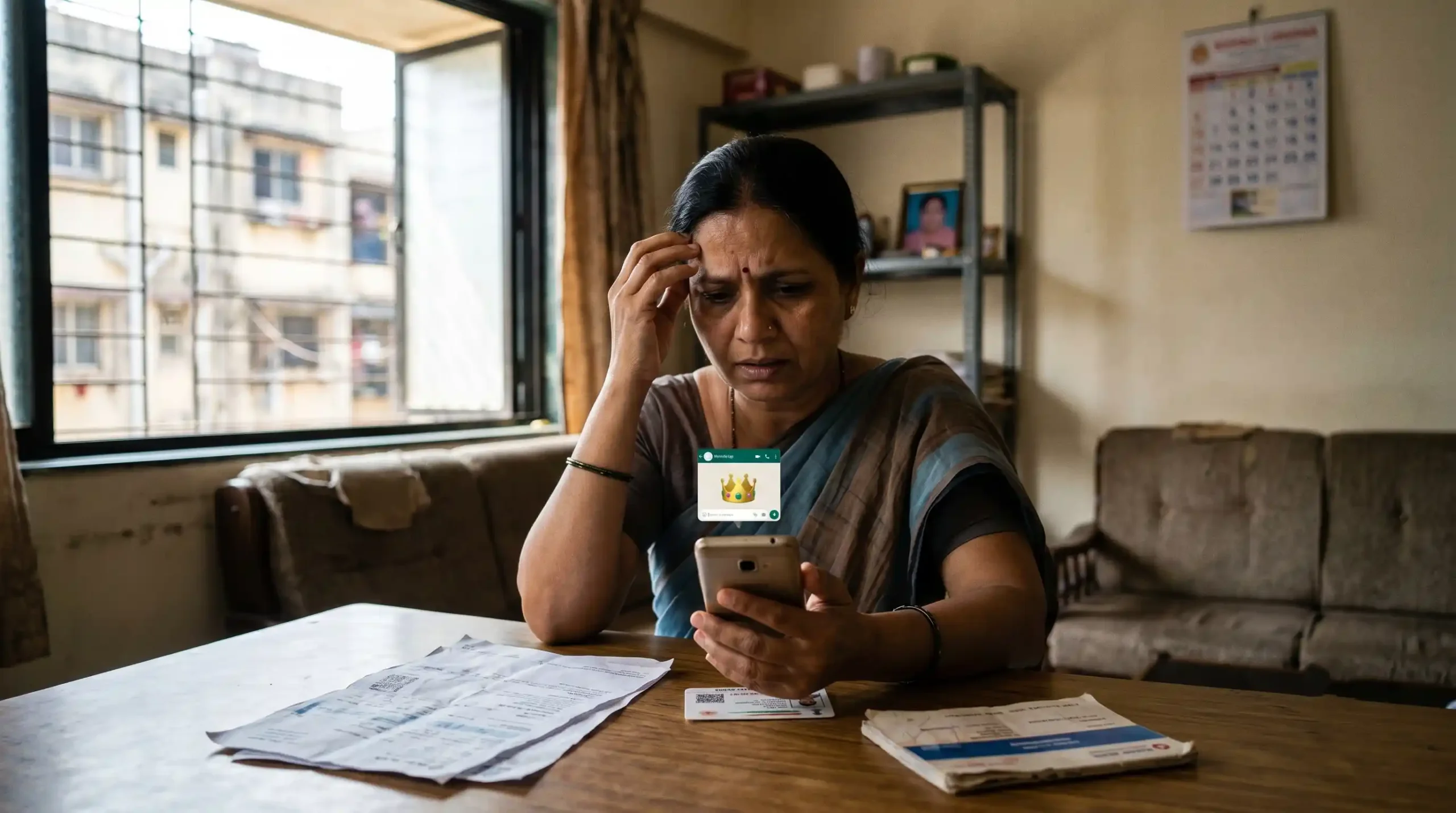
Every year, lottery fraud in India drains life savings through fake wins, harmful UPI payment requests, and highly convincing cloned celebrity video ads. Specifically, fraudsters exploit hope by using well-known brand names and government logos to create a false sense of trust. Therefore, as part of our promise to Responsible Lottery Play, this guide uncovers the exact playbook scammers use. Below, we break down the most common lottery scams in India, show how to spot the red flags, and list the immediate steps you must take to protect yourself and your family.

Key Takeaways

  • Never Pay to Win: Genuine lotteries deduct taxes before payout; consequently, they never demand an advance fee or “processing charge”.
  • Verify Independently: Always check results on official state government websites, rather than using links sent in SMS or WhatsApp messages.
  • Guard Your Details: Furthermore, a real prize claim never requires your UPI PIN, OTP, or screen-sharing access.
  • Act Fast if Scammed: Most importantly, the “golden hour” for recovery is crucial—call 1930 and contact your bank immediately.

The Most Common Lottery Scams in India

Fraudsters constantly change their tricks. Often, they use social engineering to panic or excite their victims. Here is exactly how they operate today.

The Advance Fee Lottery Scam

Also known as the “pay-to-play” or “tax fee” fraud, this is the main setup for most prize scams in India. First, victims receive a convincing message—often a forged letter or a dear lottery fake call—claiming they have won a huge jackpot. However, the scammer insists that a GST, processing fee, or customs charge must be paid upfront before the prize is released.

The Reality of Lottery Taxes in India: Under Section 393(3) of the Income Tax Act (formerly 194B), a flat 30% tax plus a 4% cess (effectively 31.2%) applies to lottery winnings over Rs. 10,000. Crucially, this is deducted at the source (TDS). Therefore, you do not pay this out of your own pocket upfront to a caller.

Social Media and Messaging App Exploits

Increasingly, scammers flock to popular messaging apps to bypass standard spam filters.

  • WhatsApp Fraud: The fake KBC lottery WhatsApp message is a famous example. Typically, fraudsters send audio notes and fake posters with celebrity photos, claiming your mobile number was randomly selected in a lucky draw. * Telegram Groups: Similarly, fraudsters create huge, fake community channels. A Telegram lottery group scam usually features staged screenshots of “winners” getting payouts. As a result, victims are tricked into paying VIP access fees or placing rigged bets. * Deepfake Endorsements: Another growing threat is the deepfake celebrity lottery endorsement. Using AI, scammers copy the faces and voices of trusted public figures to make fake video ads. Therefore, never trust a video endorsement without checking the official source. ### UPI ‘Refund’ and ‘Collect Request’ Fraud Additionally, scammers abuse India’s fast payment system. For instance, you might get a call apologizing for a “failed” lottery ticket purchase, promising a refund. Then, they will send a UPI “Collect Request” to your phone.

UPI Refund Fraud: A collect request takes money out of your account; it does not add money. Above all, you NEVER need to enter your UPI PIN to receive money. —

How to Spot a Fake Lottery Winning Message

Whether it arrives via email or as a fake lottery winning SMS , always look for these clear red flags:

  • You Didn’t Buy a Ticket: Obviously, you cannot win a lottery you did not enter. “Random mobile number selections” are always fake.
  • Urgency and Secrecy: Often, scammers demand you act within 24 hours. Furthermore, they tell you to keep your “win” a secret so you cannot ask for advice.
  • Suspicious Links: Finally, the message might contain shortened URLs or links to fake websites instead of real state government .gov.in addresses. —

How to Avoid Lottery Scams: Your Defense Playbook

Ultimately, protecting yourself requires caution and safe digital habits.

Three Steps to Stay Safe

  1. Never Share KYC Data on Unverified Channels: For example, do not send photos of your Aadhaar card, PAN card, or bank passbook over WhatsApp to claim a prize.
  2. Verify the Source: If a caller claims to be from a state lottery office, hang up immediately. Instead, find the real number on the state government’s official website and call them directly to check.
  3. Prepare for the Worst: If you realize you have been tricked, speed is your only hope. Specifically, lottery scam victim recovery depends on filing a dispute within the first 24 hours. —

Frequently Asked Questions

1. What are the most common lottery scams in India?

Currently, the most common types include advance-fee frauds (demanding tax upfront), fake KBC WhatsApp lucky draws, and Telegram groups showing fake wins. Additionally, deepfake celebrity video ads and malicious UPI “collect request” scams are spreading rapidly.

2. How do I know if a lottery win message is real or fake?

A message is almost certainly fake if you didn’t buy a ticket. Furthermore, if it asks for a processing fee, demands your UPI PIN, or forces you to keep it a secret, it is a scam. Instead, real lotteries publish results publicly on official government websites.

3. Do real lotteries ever ask for a fee to release a prize?

No. Legally, real state-run lotteries in India deduct the required 31.2% tax (TDS) before paying your prize. Therefore, they will never ask you to send money, pay a “customs fee,” or make a UPI payment to get your funds.

4. Where do I report a lottery scam in India?

First, immediately call the National Cyber Crime Helpline at 1930. Next, you must file a full, official complaint online at the National Cyber Crime Reporting Portal (cybercrime.gov.in). ### 5. Can I get my money back after a lottery scam? Recovery is hard, but it is possible if you act very quickly. Specifically, your best chance is to report the fraud to 1930 and your bank within the “golden hour”. Doing this freezes the scammer’s account before they can take the funds out.

6. Why do scammers use WhatsApp and UPI for lottery fraud?

Mainly, WhatsApp lets scammers send fake documents and voice notes easily while hiding their identity. Meanwhile, UPI is popular with scammers because it allows instant, final money transfers. Consequently, this makes it easy for thieves to empty bank accounts fast.

7. Does any lottery contact winners by call or SMS?

No official state lottery in India will ever call or text you to announce a jackpot win. Instead, it is completely the ticket holder’s job to check the published results and start the formal claim process.

8. How has the 2025 online gaming law affected lottery scams?

Recently, strict new rules forced many illegal betting websites to change their tactics. As a result, some have rebranded as fake “lottery groups” on Telegram or WhatsApp to avoid the new ad bans. Therefore, we are seeing a sharp rise in these local scams.

9. Who is most targeted by lottery scams in India?

Scammers blast fake texts and WhatsApp messages to millions of people randomly. However, they actively hunt vulnerable groups. For instance, first-time digital payment users and elderly citizens are prime targets because they might not recognize AI deepfakes or UPI “collect requests”.

10. What do I do if I already shared my bank details?

First, act instantly: contact your bank’s emergency fraud line to freeze your account and block your cards. Second, reset your UPI PIN and online banking passwords immediately. Finally, report the crime by calling 1930.

Stay Safe. Play Responsibly.

In conclusion, education is your strongest shield against lottery fraud in India. If you see a strange ad, get a weird message, or receive a pushy call, always check the facts through official state websites. Finally, always report fake callers to the authorities to protect others.